
Managing vendors for Durham rental properties requires careful planning to protect your property, tenants, and finances. Here’s what you need to know:
- Why Vendor Vetting Matters
- Poor vendor choices can result in subpar work, legal issues, and tenant dissatisfaction. These risks often escalate into costly legal steps and best practices for managing tenant disputes.
- Durham laws (e.g., City Code Sec. 10-237) require properties to meet fitness standards, with fines of $100–$500 per violation.
- Steps to Vet Vendors
- Identify property needs and required vendor types, considering Durham’s humid climate.
- Verify credentials, licenses, and insurance to ensure compliance with local regulations.
- Research vendor reputation, response times, and warranties.
- Compare estimates and establish clear service agreements.
- Test vendors with small jobs before assigning critical tasks.
- Key Considerations
- Ensure vendors know Durham’s housing codes and Section 8 standards.
- Maintain a network of 2–3 vendors per trade for flexibility.
- Use written contracts with detailed pricing and scope of work.
Bottom Line: A structured vendor vetting process minimizes risks, ensures compliance, and helps maintain tenant satisfaction. Services like Unicorn Rentals simplify vendor coordination, offering licensed providers and discounted rates.
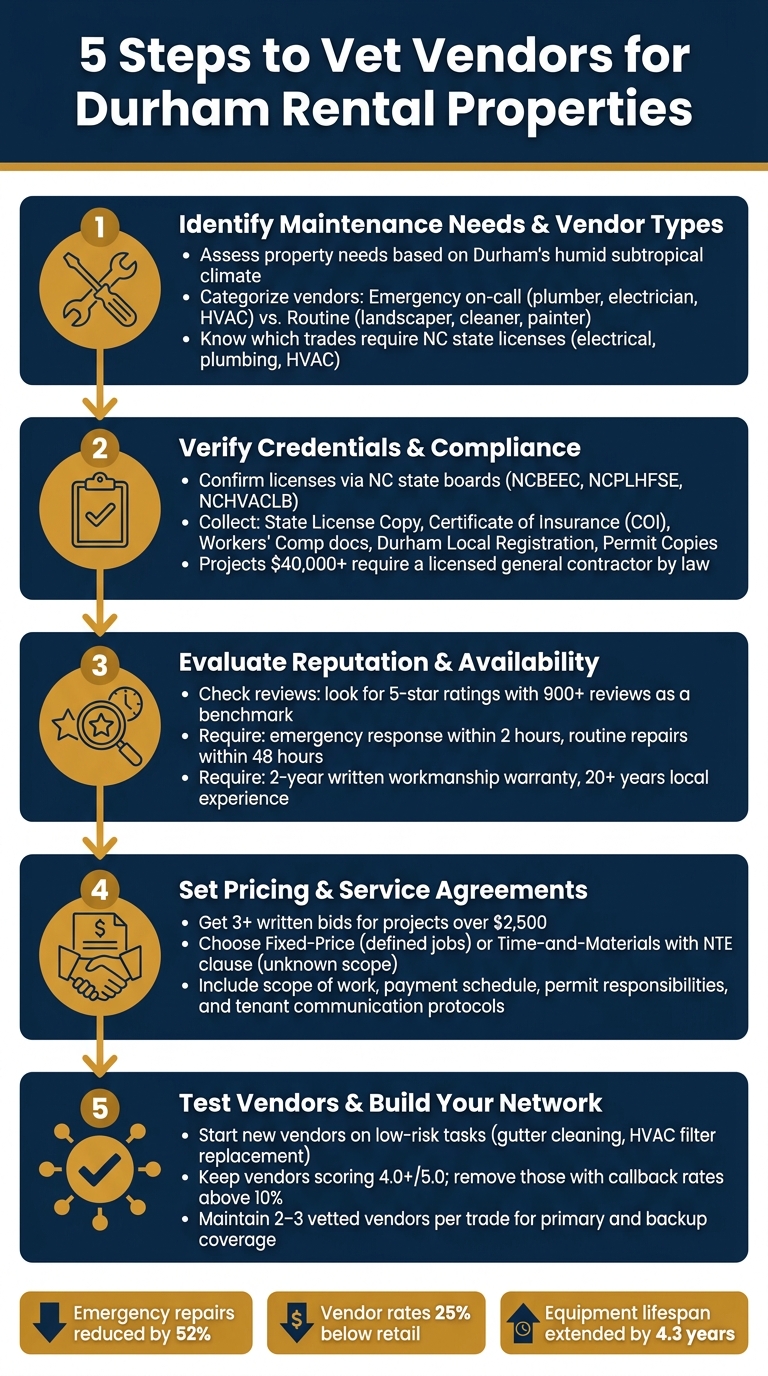
5-Step Vendor Vetting Process for Durham Rental Properties
Property Management: How to Hire Vendors and Why You NEED to have a Vendor Rating System
sbb-itb-aa27f6d
Step 1: Identify Your Maintenance Needs and Vendor Types
Start by assessing your property’s specific maintenance requirements. Durham’s humid subtropical climate can put extra strain on rental properties. For example, HVAC systems often run overtime during the hot summers, frequent rains can overwhelm gutters and drainage systems, and high humidity speeds up wear and tear on roofs and siding. These local conditions will play a big role in shaping your maintenance priorities.
Common Vendor Categories
Durham landlords typically rely on vendors in four main areas: core systems, exterior and structural upkeep, sanitation and safety, and turnover and aesthetics. To simplify things, you can separate vendors into two groups: emergency on-call services (like plumbers, electricians, and HVAC technicians) and routine service providers (like landscapers, cleaners, and painters).
| Vendor Category | Common Tasks in Durham | Licensing Required (NC) |
|---|---|---|
| HVAC Technician | AC repairs, furnace maintenance, humidity control | Yes |
| Plumber | Fixing water heaters, detecting leaks, pipe insulation | Yes |
| Electrician | Wiring updates, installing smoke detectors, panel upgrades | Yes |
| Pest Control | Rodent proofing, insect extermination | Yes (State Certification) |
| Landscaper | Lawn mowing (under 6"), leaf removal, drainage fixes | No |
| Handyperson | Drywall repairs, gutter cleaning, fence maintenance | No |
| Turnover Crew | Deep cleaning, painting, lock replacements | No |
One important detail: Durham city ordinances require that grass and weeds stay under 6 inches tall.
This breakdown makes it easier to decide which tasks need immediate attention and which can be scheduled regularly.
When a License Is Required
Understanding your vendor categories also helps you figure out when professional licensing is necessary.
In North Carolina, certain trades like electrical, plumbing, and HVAC work require state-issued licenses. These are regulated by specific boards, including the NC State Board of Examiners of Electrical Contractors, the NC State Board of Examiners of Plumbing, Heating and Fire Sprinkler Contractors, and the NC Heating and Air Conditioning Contractors Licensing Board. If a job in one of these areas requires a permit, it must be performed by a licensed professional.
"Durham requires permits for structural work, additions, electrical panel upgrades, plumbing, and HVAC installation." – CheckLicensed Editorial Team
For general contractors, licensing is based on project value: Limited (up to $500,000), Intermediate (up to $1,000,000), and Unlimited (no cap). However, smaller tasks like patching drywall, cleaning gutters, or fixing fences can usually be handled by a handyperson without the need for a permit. If you’re unsure, you can always contact Durham Inspections at 560-4144 to confirm whether a permit is required.
Once you’ve outlined your vendor types and licensing needs, the next step is to streamline how you manage them.
How Unicorn Rentals Helps with Vendor Coordination
After identifying your maintenance needs and licensing requirements, the challenge becomes managing vendors efficiently. That’s where Unicorn Rentals can make a difference. They work with a network of 37 licensed service providers in Durham, covering everything from plumbing and electrical to HVAC and general repairs. Their partnerships secure discounted rates – often 25% below retail – and their preventive maintenance plans include services like semi-annual HVAC checkups, annual water heater inspections, and quarterly gutter cleaning. This approach not only reduces emergency repair costs by 52% but also addresses 76% of potential property issues before they escalate. For landlords who prefer not to juggle a vendor list, this level of coordination can save both time and money while providing peace of mind.
Step 2: Verify Vendor Credentials and Compliance
Once you’ve determined your vendor needs, the next step is to verify their credentials, insurance, and compliance with local regulations. Skipping this can lead to costly mistakes, especially for landlords in Raleigh and Durham.
Check Licensing and Insurance
For regulated trades, always confirm credentials directly through the appropriate state board. For example:
- Electricians: Check with the NC State Board of Examiners of Electrical Contractors (NCBEEC).
- Plumbers: Verify through the NC State Board of Examiners of Plumbing, Heating and Fire Sprinkler Contractors (NCPLHFSE).
- HVAC Technicians: Use the NC Heating and Air Conditioning Contractors Licensing Board (NCHVACLB).
When hiring general contractors, search their name or license number on nclbgc.org to ensure the license is active and matches the scope of your project. Pay attention to license tiers:
- A Limited license covers projects up to $500,000.
- An Intermediate license covers projects up to $1,000,000.
"If a project is valued at $40,000 or more, your general contractor must have a license issued by the state. It’s the law." – NC Licensing Board for General Contractors
Additionally, verify local registration and request a current Certificate of Insurance (COI) from each vendor. To confirm local registration, you can contact Durham Inspections at 560-4144 or use their online portal.
Documents to Collect from Vendors
Before any work begins, make sure to gather the following documents from each vendor:
| Document | Purpose |
|---|---|
| State License Copy | Confirms the vendor is legally authorized for their trade |
| Certificate of Insurance (COI) | Ensures they have general liability coverage |
| Workers’ Compensation Documentation | Required if the vendor employs workers |
| Durham Local Registration Confirmation | Verifies they can pull permits in Durham |
| Permit Copies (for major work) | Confirms the job is authorized and inspected |
Don’t forget to verify the specialty licenses of any subcontractors involved. Keeping these records updated not only helps with compliance but also streamlines project management.
Durham Code and HCVP Standards
Once credentials are verified, ensure the vendor’s work aligns with local codes. This is especially important in Durham, where compliance with the Minimum Housing Code is required. Poor-quality work can lead to failed inspections or even citations.
If your property is part of the Housing Choice Voucher Program (Section 8), the stakes are even higher. HCVP properties must pass Housing Quality Standards (HQS) inspections. Repairs or upgrades that don’t meet these standards can result in failed inspections, delaying rental income. To avoid this, ask vendors if they have experience with Section 8 properties and HQS requirements.
"The Code Enforcement Division is here to ensure all Durham residents live in safe, healthy homes and neighborhoods… by enforcing codes and ordinances that exist to protect the quality of life of residents." – Durham Housing & Neighborhood Services
Step 3: Evaluate Vendor Reputation and Availability
Once you’ve confirmed a vendor’s credentials, the next step is to dig deeper into their reputation and reliability. It’s not just about having the right paperwork; it’s about ensuring they consistently deliver quality service and are dependable when emergencies arise. Responsiveness and trustworthiness are essential qualities to look for.
How to Research a Vendor’s Background
Start by checking online reviews, but don’t just focus on the star ratings. Pay attention to the number of reviews and whether they specifically mention work related to rental properties. For example, some of the top-rated maintenance providers in the Durham area boast 5.0-star ratings from over 934 reviews, which reflects a history of dependable service.
Also, consider how long the vendor has been operating in the cities we serve. Vendors with over 20 years of experience in the Triangle region are likely familiar with Durham’s specific building codes and the challenges posed by its humid subtropical climate. If they’ve worked extensively with rental properties, that’s an added bonus, as it shows they understand the unique demands of landlords and tenants.
With this background research in hand, it’s time to set clear expectations by asking the right questions.
Questions to Ask Before Hiring a Vendor
Here are some critical questions to help you evaluate potential vendors:
- Response Times: Can they respond to emergencies within 2 hours and start routine repairs within 48 hours?
- After-Hours Availability: Do they offer evening and weekend support, or is their availability limited during those times?
- Warranty Terms: Do they provide a written workmanship warranty? Ideally, vendors should offer a 2-year warranty to cover repairs.
- Pricing Transparency: Will they provide a detailed, itemized estimate upfront with no hidden fees?
Pay attention to how quickly they respond to your initial inquiries. Vendors who reply within 2 hours during business hours demonstrate reliability. On the other hand, delays in communication could be a warning sign.
Once you’ve gathered all this information, compare vendors side by side to identify any strengths or weaknesses.
Vendor Comparison Table
| Evaluation Criteria | Target Standard | Why It Matters |
|---|---|---|
| Emergency Response Time | Within 2 hours | Prevents serious property damage and ensures tenant safety. |
| Routine Repair Scheduling | Within 48 hours | Keeps tenants happy and stops small issues from escalating. |
| Workmanship Warranty | 2-year written guarantee | Protects against recurring repair costs. |
| Local Experience | 20+ years in the Triangle | Indicates familiarity with Durham’s codes and climate-related challenges. |
| Pricing Transparency | Upfront, itemized estimates | Avoids surprise charges and ensures clear communication about costs. |
| After-Hours Availability | Evening and weekend support | Ensures emergencies can be handled outside regular business hours. |
This side-by-side comparison can highlight gaps, such as a vendor with stellar reviews but limited after-hours support, or one with fast response times but no written warranty. By weighing these factors, you’ll be better equipped to choose a vendor who meets your needs.
Step 4: Set Clear Pricing and Service Agreements
Nailing down clear pricing and service terms is crucial for keeping your project on track and avoiding misunderstandings. Once you’ve found a trustworthy vendor, it’s time to lock in the financial details and expectations in writing. Relying on verbal agreements can lead to confusion – and costly mistakes.
How to Request and Compare Written Estimates
Ask for detailed, line-item estimates that break down everything: labor costs, material costs (including specific brands and grades), the timeline, and how any changes will be handled. This level of detail makes comparing bids much easier.
If you’re seeing big price differences between estimates, go through them with a consistent checklist. Often, the differences aren’t just about profit margins – they’re about what’s included (or left out). For projects over $2,500, aim to gather at least three written bids. And if you’re using Unicorn Rentals’ network, you may benefit from rates that are typically 25% to 30% lower than retail pricing.
Once you’ve reviewed the estimates, it’s time to formalize everything in a clear service agreement.
What to Include in a Service Agreement
A solid service agreement should cover all the essentials: a detailed scope of work, payment schedule, start and end dates, and a clear process for handling change orders. Make sure it’s clear that no extra work will proceed without written approval from both sides. Also, confirm the vendor has general liability and workers’ compensation insurance, and ensure your property is listed as an additional insured.
Don’t overlook these two often-missed details: tenant communication protocols (who informs tenants, how far in advance, and who arranges access) and permit responsibilities (who pulls the permits, pays for them, and handles city inspections). For larger or more complex projects – especially those involving structural, electrical, or plumbing work, or anything over $500 to $1,000 – always use a formal, multi-page contract instead of a simple work order.
Fixed-Price vs. Time-and-Materials Contracts
The type of contract you choose can make a big difference in managing costs and responsibilities.
"Fixed-price contracts assign full cost risk to the contractor; the homeowner pays an agreed sum regardless of the contractor’s actual costs." – National Home Services Authority
For straightforward jobs like roof replacements or exterior painting, a fixed-price contract is ideal. It provides cost certainty and shifts the financial risk to the contractor. On the other hand, for jobs like diagnosing a hidden HVAC issue or locating a leak – where the scope isn’t fully known – a time-and-materials contract makes more sense. Just be sure to include a Not-to-Exceed (NTE) clause to cap your costs and avoid runaway billing.
| Feature | Fixed-Price | Time-and-Materials |
|---|---|---|
| Cost Risk | Contractor | Property owner |
| Price Certainty | High; set before work begins | Low; depends on hours and parts |
| Best for | Defined jobs (roofing, painting) | Unknown-scope repairs |
| Admin Effort | Low; single invoice based on quote | High; requires verifying hours and receipts |
Regardless of the contract type, always insist on itemized invoices. Vague descriptions like "labor and materials" can complicate warranty claims and make resolving disputes much harder.
Step 5: Test Vendors and Build a Reliable Network
Now that you’ve set pricing and service agreements, it’s time to evaluate vendor performance and establish a strong network you can depend on.
Start New Vendors with Low-Risk Jobs
Avoid assigning untested vendors to high-stakes tasks or tenant-occupied units. Instead, begin with low-risk jobs like gutter cleaning, HVAC filter replacements, or water heater flushes. These tasks are straightforward to assess and won’t lead to major issues if the vendor doesn’t meet expectations.
Use this first assignment to evaluate the basics: Did they arrive on time? Was communication clear? Did they leave the property clean? How a vendor handles a simple task can give you a good sense of their reliability for more complex jobs. Once you’ve reviewed their performance on a basic project, you’ll have a better idea of their overall dependability.
How to Decide Whether to Keep a Vendor
After testing vendors on low-risk assignments, review their performance to determine if they meet your standards. Even a single job can reveal a lot. Key indicators include whether the work was done right the first time, if the invoice matched the estimate, and whether tenants (if involved) had any complaints. A callback rate above 10% signals trouble, while reliable vendors typically achieve a first-time fix rate between 75% and 85%.
"You’ll pay for a bad contractor twice: once for the job, and once for the consequence. The second bill is always larger." – MrTask Editorial Team
Score vendors on a scale of 1 to 5 in areas like response time, quality of work, invoice accuracy, tenant feedback, and record-keeping. Vendors who consistently score 4.0 or higher are worth keeping. On the flip side, vendors who fail to show up without notice or submit fraudulent invoices should be removed immediately. For significant quality issues, issue warnings, and for minor but recurring problems, place the vendor on a watch list.
Build a Vendor Pool with Primary and Backup Options
Your aim shouldn’t be to rely on just one plumber or electrician but to have two to three vetted vendors for each trade. This ensures you’re covered if your primary vendor is unavailable, raises prices, or goes out of business. However, keeping more than three vendors per trade can dilute your work volume, potentially making you a low-priority client.
For critical trades like plumbing and HVAC, having backup options is essential. These systems can fail in ways that lead to significant tenant impacts, like flooding or lack of heat. In Durham, where HVAC and moisture management are especially crucial, a reliable backup vendor can save you from scrambling during peak demand. For instance, Unicorn Rentals maintains a network of 37 licensed service providers in Durham, which helps them achieve a 95.2% occupancy rate and cut emergency repair costs by 52% through preventive maintenance.
To ensure prompt service, pay invoices on Net-15 terms and provide clear, written work orders. This keeps your vendors motivated and your operations running smoothly.
Conclusion: Key Steps for Vetting Vendors in Durham
A thorough vendor vetting process is essential for protecting your property, ensuring tenant safety, and staying compliant with local regulations. As mentioned earlier, even minor code violations can result in hefty fines.
The foundation of a strong vendor strategy involves four main steps: verifying vendor qualifications, ensuring familiarity with Durham’s minimum housing standards, establishing clear pricing agreements upfront, and testing new vendors with smaller, low-risk tasks before assigning critical jobs. Following this method consistently can reduce emergency repairs by up to 40% and extend the lifespan of major equipment by an average of 4.3 years, as highlighted in earlier examples.
Building and maintaining a dependable vendor network is equally important for long-term property upkeep. While creating a reliable pool of primary and backup vendors takes effort, the payoff is worth it. Landlords who tap into professional networks often secure repair rates that are 25% lower than retail, helping offset annual maintenance costs, which typically range between 1.2% and 1.8% of a property’s value.
For landlords looking to simplify vendor coordination, Unicorn Rentals offers a streamlined solution. They connect Durham property owners with 37 licensed service providers, ensuring emergency responses within two hours and routine repairs within 48 hours, all while managing rental registration requirements.
"Our maintenance coordination service connects Durham rental properties with vetted contractor networks… offering priority scheduling and negotiated rates typically 25% below retail pricing." – Unicorn Rentals
FAQs
Which repairs in Durham require a licensed contractor or a permit?
In Durham, certain repairs and construction projects need a licensed contractor or a permit. This applies to projects valued at $40,000 or more, structural work, or moving structures. Examples include foundation repairs and structural changes.
While routine maintenance or minor fixes often don’t require permits, major electrical, plumbing, or mechanical work must be handled by licensed professionals and may also need permits. Always check local regulations to ensure compliance.
What documents should I collect before a vendor starts work on my rental?
Before allowing a vendor to start work on your rental property, make sure to gather these key documents:
- Certificate of Insurance (COI) listing Additional Insured endorsements to confirm liability coverage.
- Trade-specific licenses, verified with the relevant state board, to ensure the vendor is properly certified.
- W-9 form with a valid Taxpayer Identification Number (TIN) for tax reporting purposes.
- Proof of Workers’ Compensation insurance, if applicable, to protect against potential workplace injuries.
- A signed vendor agreement that clearly defines the scope of work, pricing, and compliance expectations.
Collecting these documents helps ensure you’re legally covered, expectations are clear, and all necessary protections are in place.
How do I test a new vendor without risking tenant complaints or damage?
Testing out a new vendor can be done safely by starting with a low-risk trial job. This could be something straightforward, like routine maintenance or handling work in vacant units. During this trial, pay attention to key factors such as their punctuality, communication skills, quality of work, and accuracy in invoicing.
Before assigning even a trial job, make sure to verify their credentials. This includes checking for proper licensing, liability insurance, and workers’ compensation coverage. These steps help protect you from potential issues down the line.
Once the trial is complete, take the time to document your evaluation. This record will help you make informed decisions about whether the vendor is reliable enough to handle more critical tasks in the future.