Managing rental properties in the Triangle area (Raleigh, Durham, Chapel Hill) involves more than rent collection. Property managers handle tenant screening, financials, maintenance, legal compliance, and more. Here’s a quick breakdown of their seven key responsibilities:
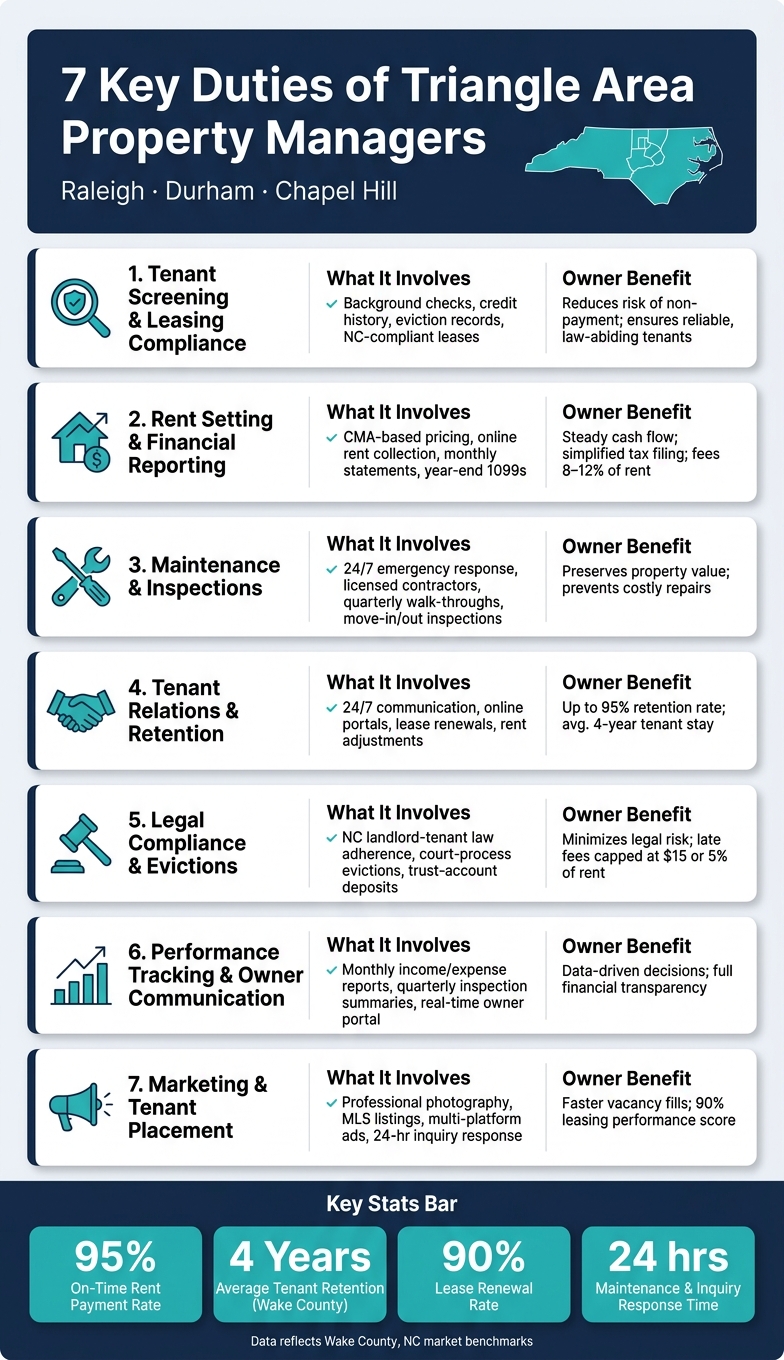
- Tenant Screening & Leasing Compliance: Selecting reliable tenants with background checks and ensuring leases meet North Carolina laws.
- Rent Setting & Financial Reporting: Pricing rentals competitively, collecting payments online, and providing detailed financial reports.
- Maintenance & Inspections: Coordinating repairs, conducting inspections, and ensuring properties meet safety standards.
- Tenant Relations & Retention: Maintaining communication and addressing concerns to keep tenants long-term.
- Legal Compliance & Evictions: Navigating landlord-tenant laws, handling disputes, and managing evictions legally.
- Performance Tracking & Communication: Monitoring rental performance and keeping owners informed with regular updates.
- Marketing & Tenant Placement: Advertising properties effectively to reduce vacancies and attract quality tenants.
Professional property managers streamline these tasks, ensuring compliance with local laws and optimizing property performance. This is especially valuable in a competitive market like the Triangle, where tenant retention rates can reach 95%.
7 Duties of Triangle Area Property Managers: Roles, Benefits & Local Rules
What Does a Property Manager Actually Do?
sbb-itb-aa27f6d
1. Tenant Screening and Leasing Compliance
Picking the right tenant isn’t just important – it’s essential. A bad tenant can lead to missed rent, property damage, or even legal headaches. That’s why property managers in the Triangle area use a thorough screening process that goes beyond just reviewing applications.
This process typically includes background checks, credit history reviews, and eviction records to identify potential risks. Every step is carefully aligned with North Carolina landlord-tenant laws, which outline rules for fair housing, security deposits, and lease disclosures. Skipping or mishandling these steps can leave property owners exposed to serious legal issues. Once a tenant is selected, the focus shifts to creating lease agreements that fully comply with state regulations.
Lease compliance is just as important. A solid lease covers all the details – like rules about pets, appliances, and maintenance responsibilities – while protecting the property owner’s rights. Property managers ensure these contracts meet North Carolina’s legal standards, which is especially critical in competitive markets like Raleigh and Durham.
This attention to detail pays off. In Wake County, data shows 95% of tenants pay rent on time, and the average tenant stays for 4 years. The lease renewal rate is also impressive, sitting at 90%.
Unicorn Rentals applies these rigorous standards to every property it manages – whether it’s a single-family home, condo, townhome, or multi-family unit – throughout Wake, Durham, and Orange counties.
2. Rent Setting, Collection, and Financial Reporting
Getting the rent just right is a big deal. Property managers in the Triangle area rely on a Comparative Market Analysis (CMA) to figure out the best rent price. This involves looking at factors like the property’s age, condition, included appliances, pet policies, and amenities like a community pool or gym. Setting the right rent from the start is key to taking advantage of local market insights.
Rental markets in the Triangle – whether it’s North Raleigh, downtown Durham, which requires specialized Durham property management expertise, or suburban spots like Cary or Holly Springs – are all different. Each area attracts its own type of tenants, with varying expectations and budgets. Skilled property managers use their local expertise to fine-tune pricing, balancing tenant satisfaction with maximizing returns. Once the rent is set, the focus shifts to making the payment process as smooth as possible.
Streamlined Rent Collection
Rent collection is made easier with online portals that handle payments automatically. These systems apply late fees in line with North Carolina law and ensure funds are sent directly to property owners. This efficient setup helps professional managers in the Triangle achieve an impressive 95% on-time rent payment rate.
Transparent Financial Reporting
Owners receive monthly statements that break down income, maintenance expenses, and fees. At tax time, year-end documents like 1099s are provided, making it simple to keep track of your property’s financial performance.
It’s also important to understand the costs of property management. In Raleigh-Durham, management fees typically fall between 8% and 12% of the rent, with leasing fees ranging from 50% to 100% of one month’s rent. There may also be lease renewal fees of $200 to $300 and annual administration fees. For example, Unicorn Rentals stands out by offering no setup or hidden fees. Their Tier 3 Premium plan even includes free lease renewals and no repair markups, which can save owners a lot over time. Transparent pricing like this highlights the value of comprehensive property management services, especially from providers like Unicorn Rentals.
3. Maintenance Coordination and Property Inspections
Keeping a property in great condition goes beyond tenant screening and financial management. Timely maintenance and regular inspections are essential for maintaining property value. Tenants expect quick responses when issues arise, and in the Triangle area, many property managers offer a 24-hour response guarantee for maintenance emergencies. This quick action not only resolves problems efficiently but also helps prevent costs from spiraling out of control. From the moment a request comes in to scheduling the right contractor, property managers handle it all – letting owners stay stress-free.
A key part of effective maintenance is having a reliable network of vendors. Skilled property managers work with licensed and insured contractors across Raleigh, Durham, Cary, and Wake County. As Unicorn Rentals puts it:
"Emergency and routine maintenance with our network of licensed, insured contractors serving Raleigh, Durham, Cary, and Wake County."
Many property managers also use digital maintenance portals. These tools allow tenants to submit requests, upload photos, and even track the progress of repairs in real time. This transparency keeps everyone on the same page and creates a helpful record if any disputes come up later.
On the inspection side, regular checks are just as important. Standard practices include move-in/move-out inspections, quarterly walk-throughs, and routine checks of the property’s exterior. These inspections not only protect your investment but also ensure compliance with North Carolina laws, which require rental properties to be kept in a "fit and safe" condition. During inspections, managers also check smoke and carbon monoxide detectors, as required by state law. For properties in HOA communities – common in the Triangle area – managers ensure the exterior meets the neighborhood’s standards.
| Inspection Type | Frequency | Purpose |
|---|---|---|
| Move-in/Move-out | At lease start/end | Document the property’s condition for deposits |
| Quarterly Walk-through | Every 3 months | Catch preventive maintenance issues early |
| Safety Compliance | During all visits | Ensure smoke/CO detectors are working |
| Exterior/HOA | Routine | Verify compliance with HOA rules |
Prompt and well-organized maintenance doesn’t just keep properties in top shape – it also improves tenant retention. In competitive markets like Wake County, tenants often cite efficient repairs as a major factor in renewing their leases. This attention to detail can lead to retention rates as high as 95%. By staying proactive, property managers build strong tenant relationships and set the stage for long-term success.
4. Tenant Relations and Retention
Building strong tenant relationships takes effort – it’s all about consistent communication and timely action. In the Triangle area, property managers who make themselves accessible often enjoy higher tenant retention. This stability helps property owners avoid the headaches and costs associated with vacancies and frequent turnover. Good tenant relationships don’t just improve retention – they also make managing leases more efficient.
Accessibility plays a big role in tenant satisfaction. Instead of relying on impersonal automated systems, many property managers in the Triangle prioritize a personal touch, supported by easy-to-use technology:
"We answer our phones, respond to emergencies 24/7, and provide the personalized service that both property owners and tenants deserve." – Unicorn Rentals
Tools like online portals make life easier for tenants by allowing them to pay rent, request maintenance, and track repairs directly from their phones. When tenants feel their concerns are addressed promptly, they’re far more likely to stick around.
Lease management is another area where skilled property managers shine. Instead of letting leases expire without a plan, they actively work on lease extensions and rent adjustments to retain dependable tenants. Keeping a good tenant is almost always cheaper than finding a new one, especially in a competitive market like Raleigh-Durham. Tenant placement fees alone can cost 50% to 100% of one month’s rent.
5. Legal Compliance, Risk Management, and Eviction Support
Alongside tenant screening and maintenance, staying on top of legal requirements is a must for protecting your investment. North Carolina’s landlord-tenant laws can be tricky to navigate. Even small missteps – like incorrectly applying a late fee or mishandling a security deposit – can lead to legal problems. This is where licensed property managers become invaluable.
For example, late fees in North Carolina are limited to $15 or 5% of the monthly rent, whichever is higher. Security deposits for annual leases cannot exceed two months’ rent, and landlords must return the deposit – or provide an itemized list of damages – within 30 days after the lease ends. Property managers not only track these deadlines but also ensure that deposits are held in legally compliant trust accounts, as required by state law.
Evictions, if necessary, must be handled through the court’s summary ejectment process. Attempting "self-help" evictions – like changing locks or shutting off utilities – is illegal and carries harsh penalties. As Unicorn Rentals explains:
"If you’re dealing with a difficult tenant or situation, we can step in and take over."
These legal protections, combined with other management duties, significantly reduce risks for property owners.
To avoid Fair Housing Act violations, property managers use consistent screening standards and keep detailed records, including documentation from regular inspections and move-in/move-out walkthroughs. This paper trail can be crucial if a security deposit dispute escalates to court. Additionally, North Carolina requires any individual or company managing property for payment to hold a real estate license issued by the NC Real Estate Commission (NCREC). Verifying your property manager’s credentials isn’t just a good idea – it’s a legal necessity.
6. Rental Performance Tracking and Owner Communication
Property managers play a key role in monitoring how well a rental property is performing as an investment while keeping owners in the loop. Just like tenant screening or coordinating maintenance, staying on top of performance metrics is essential for reducing vacancies and cutting down on turnover costs.
By tracking data like on-time rent payments, tenant retention rates, and vacancy periods, managers can gauge how things are going and make smart adjustments. For example, AI-powered pricing tools help property managers keep an eye on local competition and tweak rent rates when needed. This is especially helpful in areas like the Triangle, where rental demand can shift dramatically from one neighborhood to another.
Keeping owners informed is just as important. Regular reporting provides a clear picture of performance trends and maintenance updates. Owners typically receive a variety of reports, such as monthly income and expense statements, quarterly property inspection summaries, and year-end tax documents like consolidated 1099 forms. Many property management firms also offer online portals where owners can access real-time updates on finances and maintenance. These tools give owners instant visibility into their property’s financial status.
"Our team brings together real estate expertise, property maintenance knowledge, and a commitment to transparent communication." – Unicorn Rentals
The table below outlines the key reports that property owners can expect:
| Report Type | Frequency | What It Covers |
|---|---|---|
| Monthly Owner Statement | Monthly | Income, expenses, and net cash flow |
| Inspection Report | Quarterly / Move-in/out | Property condition, photos, and required repairs |
| Year-End Tax Documentation | Annually | Consolidated 1099s and annual expense summaries |
| Market Analysis | As needed | Local rent comparisons and strategy adjustments |
| Maintenance Updates | Real-time | Repair status and emergency coordination |
These reports ensure property owners have the information they need to make smart, timely decisions about their investments.
7. Property Marketing and Tenant Placement
Once strong tenant relations and retention strategies are in place, the focus shifts to effective marketing and placement to ensure properties remain fully occupied.
In the Triangle, one of the biggest challenges is filling vacancies quickly with reliable tenants. This process involves more than just posting a listing – it requires a strategic approach that blends high-quality visuals, widespread distribution, and data-backed pricing strategies.
Most property managers start by using professional photography to create eye-catching listings. These listings are then shared across various digital platforms and the MLS, connecting with a broad network of real estate agents and potential tenants in Raleigh, Durham, Chapel Hill, and nearby areas. Just like good maintenance and tenant relations help retain tenants for the long term, targeted marketing and efficient placement are key to quickly filling vacancies. Marketing strategies are also fine-tuned to highlight the unique appeal of each neighborhood.
Accurate pricing is another critical piece of the puzzle. Managers conduct free property analyses that take into account factors like neighborhood trends, the property’s age, included utilities, and available amenities to set competitive rental rates. As Unicorn Rentals puts it:
"There are many factors that determine rent such as neighborhood, age of home, included utilities, lease structure (pets, appliances, amenities), and condition."
Speedy responses to inquiries also play a big role. Leading firms aim to respond within 24 hours. Unicorn Rentals, for example, boasts a 90% performance score for metrics like leasing velocity and time-to-lease. Once a suitable applicant is identified, managers complete the placement process with thorough checks to ensure legal compliance and tenant quality. This careful attention to detail contributes to a 95% tenant retention rate in Wake County, where tenants typically stay for an average of four years.
This seamless process – from marketing to tenant placement – adds to the overall efficiency and value of property management in the Triangle.
Comparison Table
Here’s a quick breakdown of the seven main duties and how they benefit property owners in the Triangle market.
| Duty | What It Involves | Owner Benefits | NC & Local Considerations |
|---|---|---|---|
| 1. Tenant Screening | Conducting background, credit, criminal, and eviction checks | Helps reduce the risk of non-payment and ensures reliable tenants | Must align with NC landlord-tenant laws and Fair Housing regulations |
| 2. Rent & Financials | Online rent collection, enforcing late fees, providing monthly statements, and year-end tax documentation | Ensures steady cash flow and simplifies tax filing | Late fees are capped in NC at $15 or 5% of rent, whichever is greater |
| 3. Maintenance & Inspections | 24/7 emergency coordination, routine repairs, quarterly inspections, and move-in/out assessments | Maintains property value and prevents small issues from becoming major problems | Must adhere to NC habitability standards and CO/smoke detector requirements |
| 4. Tenant Relations | Handling communication, resolving disputes, and managing lease renewals | Can achieve up to a 95% retention rate, reducing turnover costs | Tenants in the Triangle expect responsive and locally knowledgeable service |
| 5. Legal & Risk | Drafting leases, filing evictions, and ensuring safety compliance | Reduces legal risks and ensures professional handling of sensitive issues | Must comply with NCGS Chapter 42; security deposits are required to be held in trust accounts |
| 6. Performance Tracking | Market analysis, ROI reporting, and owner statements | Supports informed decisions on rent adjustments and upgrades | Expertise spans Raleigh, Durham, and Chapel Hill markets |
| 7. Marketing & Placement | Professional photos, MLS listings, and advertising across platforms | Leads to quicker vacancy fills and attracts more applicants | High demand in areas like Knightdale and Wake Forest |
Service Tiers and Pricing
Unicorn Rentals offers three pricing tiers designed to simplify property management for owners. Each tier includes a range of services tailored to different needs.
| Plan | Monthly Fee | Additional Benefits |
|---|---|---|
| Tier 1 – Standard | 10% (7% for 5+ units) | Includes marketing, tenant screening, rent collection, maintenance coordination, and financial reporting |
| Tier 2 – Value+ | 13% (10% for 5+ units) | Adds rent loss guarantees, eviction guarantees, malicious damage coverage, and liability coverage |
| Tier 3 – Premium | 15% (12% for 5+ units) | Offers no repair markups, free lease renewals, discounted tenant placement fees, and preventive inspections |
The Value+ tier is ideal for properties with rent of at least $1,500/month – a common range for Triangle properties, where Knightdale’s average rent is approximately $1,895/month. The Premium tier is perfect for owners aiming to avoid surprise repair costs and reduce tenant placement expenses. Best of all, none of the tiers include setup or hidden fees.
Conclusion
Managing a rental property in the Triangle involves much more than just collecting rent. From adhering to North Carolina’s landlord-tenant laws to ensuring tenant satisfaction and property upkeep, these seven responsibilities capture the essence of professional property management in the area.
Each role – whether it’s tenant screening, financial reporting, or handling maintenance and legal requirements – plays a crucial part in protecting your investment and boosting its profitability. Together, these efforts turn your property into a dependable source of income.
"Property management is the backbone that turns a rental property into a consistent income-producing asset rather than a liability." – Brandy Nemergut, Realtor, Be Sunshine Realty Group
For property owners in the Triangle who prefer not to manage these tasks themselves, Unicorn Rentals offers comprehensive services across Wake, Durham, and Orange counties. Their results speak volumes, with 95% of rents paid on time and an impressive 4-year average tenant retention period in Wake County. As a locally owned company, they provide personalized service without relying on corporate call centers.
"We’re not a faceless corporate property management firm. You’ll work directly with our experienced team who live and work in the communities we serve." – Unicorn Rentals
Triangle property owners can take advantage of a free property analysis to uncover their rental’s full potential.
FAQs
Do I legally need a licensed property manager in North Carolina?
No, in North Carolina, you’re not required to hire a licensed property manager for your rental property. You have the option to manage it yourself, provided you adhere to all applicable state and federal landlord-tenant laws. That said, many property owners prefer to work with professionals, such as the licensed team at Unicorn Rentals. They can help ensure compliance with regulations, take care of tasks like tenant screening and property maintenance, and safeguard your investment from potential costly errors.
What should I look for in a Triangle property management fee breakdown?
When examining a Triangle property management fee breakdown, it’s important to understand the charges and their timing. Verify whether fees are calculated based on rent collected rather than rent due – this ensures you aren’t charged during vacancy periods. Pay close attention to key details like the monthly management fee percentage (usually between 8% and 12%) and additional costs. These may include tenant placement fees, maintenance markups, lease renewal charges, and inspection fees. Scrutinizing these elements can help you spot any unexpected or hidden expenses.
How often should a property manager inspect my rental?
Property managers usually conduct inspections during move-in and move-out to record the property’s condition. On top of that, quarterly preventive maintenance inspections are common practice. These inspections help identify potential issues early, like HVAC problems, plumbing leaks, or malfunctioning smoke detectors. Unicorn Rentals takes care of these quarterly inspections to help protect your property and reduce the risk of expensive repairs.