

If you have time, live close to the property, and know North Carolina rental rules, I’d lean toward self-managing. If you’re short on time, live far away, or want less day-to-day hassle, I’d hire a property manager.
Here’s the short version:
- Self-managing costs less upfront, but I take on the work, tenant calls, repairs, notices, and legal deadlines.
- Hiring a manager costs about 8%–12% of monthly rent, plus a leasing fee during turnover.
- On a $2,000/month rental, that usually means about $160–$240 per month, plus about $1,000–$2,000 when placing a new tenant.
- In North Carolina, I still need to think about security deposit limits, late fee rules, habitability duties, and the 10-day notice used before filing for nonpayment eviction.
- Time matters more than many owners expect: self-management can take about 8–12 hours per month per property, and 20–40 hours during turnover.
What this comes down to is simple: money, time, control, and risk.
I’d look at six things before deciding:
- Leasing and marketing
- Tenant screening
- Rent collection
- Maintenance calls
- Legal compliance
- Tenant communication
Quick Comparison
| Option | Main Cost | Time From Me | Control | Risk on Me | Best Fit |
|---|---|---|---|---|---|
| Self-manage | No monthly management fee | 8–12 hrs/month; more during turnover | High | Higher | Local owner with time and 1 unit |
| Hire a manager | 8%–12% of rent + leasing fee | Low day-to-day time | Lower direct control | Lower day-to-day exposure | Busy, out-of-area, or multi-unit owner |
A simple example helps. On a $2,000/month Raleigh-area rental, I might save around $1,920–$2,880 per year by not paying monthly management fees. But if I price the unit $100 too low, miss legal steps, or lose 2 weeks of rent to vacancy, a lot of that savings can disappear fast.
So if I want a rental to feel more like a side job, I’d self-manage. If I want it to feel more like a passive investment, I’d pay for management.
The rest of the article breaks down those tradeoffs in plain English so you can see which path fits your property, schedule, and risk tolerance.
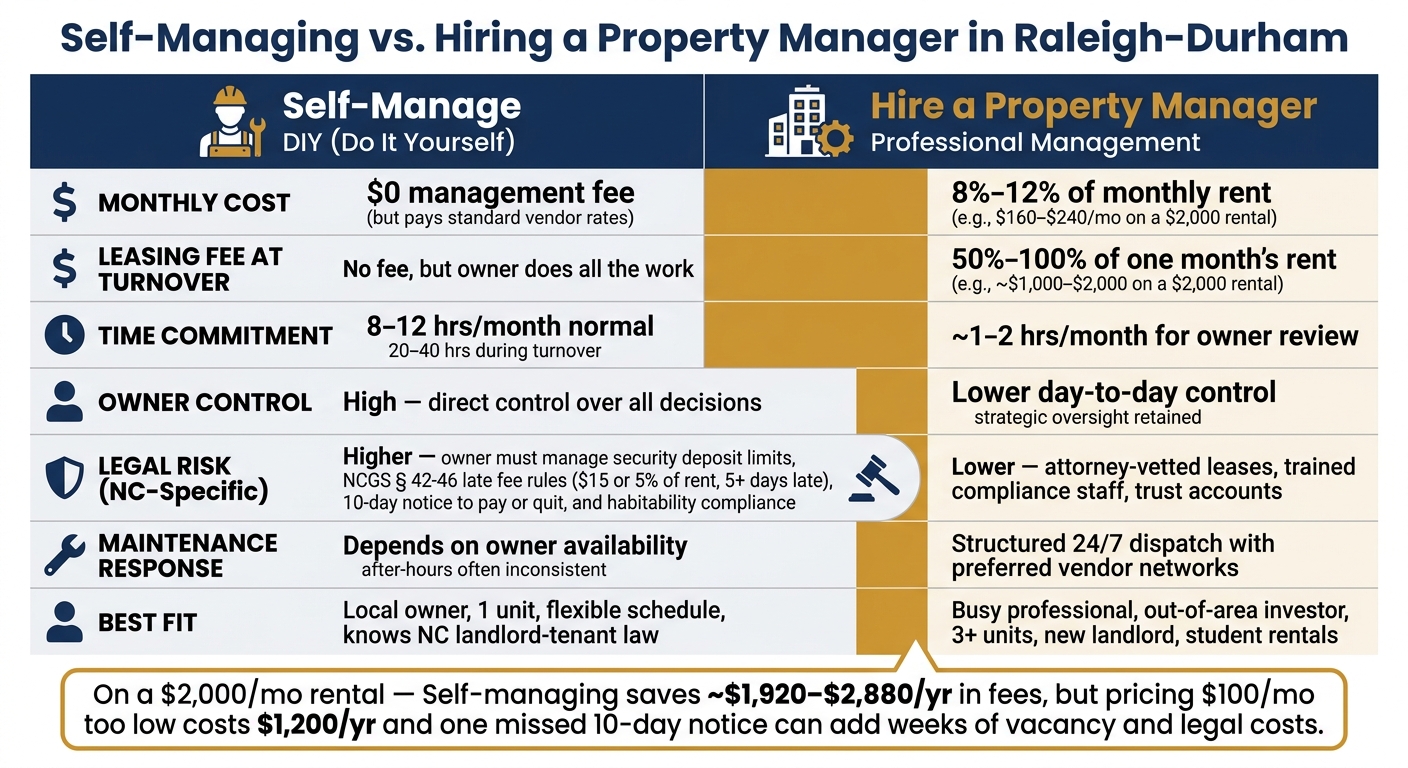
Self-Managing vs. Hiring a Property Manager in Raleigh-Durham: Cost, Time & Risk Breakdown
Should I Hire a Property Manager or Self Manage? (The Real Math)
sbb-itb-aa27f6d
What Self-Managing a Rental Actually Requires in North Carolina
Self-management means you handle leasing, maintenance, rent collection, and compliance on your own. In the Triangle, that’s not a side task you check once in a while. It’s active, hands-on work. The upside is lower out-of-pocket cost. The downside is simple: more time, more availability, and more risk.
Daily Tasks, Time Demands, and Availability Requirements
During a turnover, you’re the one taking photos, writing listings, scheduling showings, screening applicants, preparing the lease, and handling deposits. After move-in, the job changes but it doesn’t slow down. Now you’re collecting rent, following up on late payments, coordinating repairs, keeping records, and dealing with emergencies. A burst pipe or dead HVAC unit won’t wait until Monday morning.
Under normal conditions, the time commitment runs 8–12 hours per month per property, with 20–40 hours during turnovers. If you also work a full-time job, that can turn into the least profitable part of owning the rental. You save money on management fees, but you pay for it with your time and your attention.
North Carolina Compliance Tasks Self-Managing Landlords Must Handle
North Carolina has specific rules around deposits, notices, and habitability. Security deposits are capped based on lease type:
- Up to two weeks’ rent for week-to-week tenancies
- Up to 1.5 months’ rent for month-to-month tenancies
- Up to two months’ rent for longer-term leases
After move-out, you generally have 30 days to return the deposit with itemized deductions. If you can’t finish that accounting in time, you can send an interim accounting by day 30 and finalize within 60 days.
Late fees are also tightly controlled. Under NCGS § 42-46, you can charge only the greater of $15 or 5% of the monthly rent, and only after rent is 5 or more days late. You get one fee per late payment.
If a tenant stops paying, North Carolina’s default rule requires a 10-day notice to pay or quit before you can file a Summary Ejectment case in Small Claims court. From notice to lockout, an uncontested nonpayment eviction usually takes 30–60 days total.
You’re also on the hook for keeping the property fit and habitable under North Carolina’s Residential Rental Agreements Act. That includes working plumbing, electrical service, heat, and other key systems. Miss a rule, miss a deadline, or handle a repair badly, and the issue lands on your desk.
| Responsibility | Self-Management | Property Manager |
|---|---|---|
| Security Deposit Handling | Owner manages deposit accounting and move-out itemization | Manager handles deposit accounting and itemized deductions |
| Late Fee Compliance | Owner must apply the correct formula under NCGS § 42-46 | Manager applies statutory limits automatically |
| Nonpayment Notices | Owner serves the 10-day notice and tracks deadlines | Manager issues notices and monitors compliance |
| Habitability & Repairs | Owner responds to maintenance and after-hours emergencies | Manager coordinates repairs and dispatches vendors around the clock |
| Eviction Process | Owner files Summary Ejectment and handles court appearances | Manager coordinates filings and court representation |
| Tenant Screening | Owner runs credit, criminal, and income checks manually | Manager uses professional screening software |
| Time Commitment | 8–12 hrs/month; 20–40 during turnover | Roughly 1–2 hrs/month for owner review |
Those are the core demands of self-management. The next section looks at what changes when you hire a property manager.
What Changes When You Hire a Property Manager
When you hire a full-service property manager, the day-to-day work mostly leaves your hands.
That means leasing, tenant screening, rent collection, maintenance, inspections, and eviction coordination move to the manager. Your job gets much narrower. In most cases, you’re still involved in:
- pricing strategy
- lease renewals
- repair approvals above a set limit, often around $300 to $500
- capital spending
- insurance decisions
That’s the core tradeoff. You do less work and take on less direct risk, but you now pay a management fee.
Typical Property Management Fees in Raleigh-Durham
After the workload shifts, the next thing most owners look at is cost.
In the Triangle, full-service property management usually costs about 8%–12% of monthly rent. Many single-family rentals fall closer to 8%–10%. On top of that, leasing fees are often charged as a one-time fee equal to 50%–100% of one month’s rent each time a tenant turns over.
Example monthly fees:
| Monthly Rent | 8% Management Fee | 10% Management Fee | 75% Leasing Fee Example |
|---|---|---|---|
| $1,500/mo | $120/mo | $150/mo | $1,125 |
| $2,000/mo | $160/mo | $200/mo | $1,500 |
| $2,500/mo | $200/mo | $250/mo | $1,875 |
The headline rate doesn’t tell the whole story.
You’ll also want to ask about lease renewal fees, inspection fees if they aren’t bundled, and whether the company adds a markup to vendor invoices in the 10%–25% range. Some firms fold those charges into a higher monthly fee. Others break them out line by line.
So when you compare options, look at the total annual cost based on your actual rent, plus one turnover and the maintenance calls you expect in a normal year. That’s a much better apples-to-apples view.
Professional marketing can also cut vacancy time. For a $2,000/month unit, avoiding two weeks of vacancy preserves about $1,000 in rent. That number can offset part of the management cost, which is why total cost matters more than the base fee alone.
How Unicorn Rentals Structures Full-Service Management
Unicorn Rentals provides residential property management across the Triangle, including Raleigh, Durham, Chapel Hill, Cary, Apex, and Wake Forest. It offers three pricing tiers built around different service levels and different amounts of owner protection.
| Feature | Standard (10%) | Value+ (13%) | Premium (15%) |
|---|---|---|---|
| Monthly Fee (1–4 units) | 10% of rent | 13% of rent | 15% of rent |
| Monthly Fee (5+ units) | 7% of rent | 10% of rent | 12% of rent |
| Core Services | Marketing, tenant screening, rent collection, 24/7 maintenance coordination, financial reporting | All Standard services | All Standard services |
| Owner Protections | None specified | Loss of rent guarantee, eviction protection, malicious damage coverage, liability coverage | All Value+ protections, plus theft coverage and lock rekeying |
| Additional Benefits | – | Discounted tenant placement fees | No markup on vendor invoices, free lease renewals, preventive maintenance inspections, discounted tenant placement fees |
| Setup / Hidden Fees | None | None | None |
| Minimum Rent Requirement | None | $1,500/month | None |
Those tier differences only matter if they match your budget, how much control you want to keep, and how much risk you’re willing to carry yourself.
Side-by-Side Comparison: Cost, Control, Risk, and Tenant Experience
Cost vs. Convenience in Real Dollar Terms
Start with the fee. On a $2,000/month rental, an 8% management fee comes to $160/month, or $1,920/year. At first glance, that can feel like money out the door.
But doing it yourself has costs too, and many of them don’t appear neatly on a spreadsheet. Price the unit $100/month too low, and that’s $1,200/year gone. Handle repairs on your own without vendor discounts, and those bills can climb fast. In a year with one turnover, a managed $2,000 rental may cost about $3,920 in direct fees, yet part of that can be offset by faster leasing and stronger pricing.
Once you factor in time, risk, and the tenant’s day-to-day experience, the difference between paying a fee and saving money gets a lot smaller.
Control vs. Reduced Risk and Smoother Day-to-Day Operations
Self-management gives you full authority over every choice. You decide who rents the property, which contractor gets the job, and how to deal with late rent. For some owners, that kind of control matters a lot.
The flip side is simple: every problem lands on your plate. If a pipe bursts at 2 a.m. during a Raleigh winter, that call is yours. So are after-hours repairs, leasing delays, and turnovers that come with a pile of compliance steps.
Professional management puts those daily tasks into set systems: 24/7 maintenance dispatch, documented work orders, and staff trained on compliance. That can matter more than owners first think. A fair housing violation can bring steep federal penalties, and a poor eviction notice can lead to court costs, attorney fees, and weeks of vacancy.
Here’s the tradeoff in plain terms.
| Aspect | Self-Management | Professional Management |
|---|---|---|
| Cost | No monthly fee; pays standard vendor rates; higher vacancy risk | 8%–10% monthly fee plus leasing costs; vendor discounts; lower vacancy risk |
| Owner Control | Direct control over all decisions and tenant interactions | Strategic oversight; daily operations handled via documented processes |
| Legal Exposure | Higher risk without formal training in NC landlord-tenant and fair housing law | Lower risk via attorney-vetted leases, trust accounts, and trained compliance staff |
| Maintenance Response | Depends on owner availability; after-hours coverage often inconsistent | Structured 24/7 dispatch with preferred vendor networks |
| Leasing & Marketing | Limited marketing reach; more manual screening; higher vacancy risk | Multi-channel listings, professional photos, data-driven pricing, standardized screening |
| Tenant Communication | Direct, but limited by owner availability | Centralized portals, documented notices, predictable processes |
The next step is figuring out which tradeoff matters most for your property: cash flow, control, or lower risk. That’s usually what decides whether you need tighter hands-on control or more hands-off support.
Which Option Fits Your Property, Schedule, and Investment Goals
When Self-Management Makes Sense
Once you compare cost, control, and risk, the next step is simple: match the option to your property and your schedule.
If you own one home or townhome, live within 30 minutes, and have some flexibility in your week, self-management can stay pretty manageable. The same goes if you know NC landlord-tenant rules well enough to deal with tenant communication on your own. That gives you a strong starting point.
Self-management can also work well if you’re able to take care of minor repairs yourself. Doing some of that work on your own can cut maintenance spending. And with one stable, long-term tenant, your month-to-month involvement may shrink to just a few hours.
When Hiring a Manager Is the Better Fit
More distance, more units, or less time tends to shift the math toward professional management. A busy professional in Research Triangle Park who can’t reliably take after-hours maintenance calls is carrying more risk.
Once you get to three or more units, the combined work of maintenance scheduling, rent collection, lease enforcement, and bookkeeping usually starts to outrun what most owners can juggle with a full-time job. Professional management uses standard systems that can handle growth. Manual tracking usually can’t keep up for long.
Here’s a quick fit check:
| Landlord Profile | Recommended Path | Key Reason |
|---|---|---|
| Local owner, 1 unit, flexible schedule | Self-manage | Proximity and availability |
| Busy professional in Cary, Durham, or Apex | Hire a manager | High opportunity cost; needs after-hours coverage |
| Out-of-state or out-of-area investor | Hire a manager | Distance makes emergency response and compliance unworkable |
| Owner with 3+ scattered single-family homes | Unicorn Rentals full-service management | Systemized operations handle volume, maintenance, and compliance |
| Student rental near UNC, Duke, or NC State | Hire a manager | High turnover and frequent move-in/move-out cycles |
| New landlord, low risk tolerance | Hire a manager | Professional screening and NC legal compliance reduce liability |
Conclusion: The Right Choice Depends on Time, Risk, and Ownership Goals
The best path is the one that fits your time, your comfort with risk, and the way you want to own rentals. Self-management can lower direct fees, but it also asks for steady time, close legal attention, and the willingness to deal with problems as they happen – nights, weekends, and everything in between. Hiring a property manager adds a monthly fee, but it takes most of the day-to-day work off your plate.
A simple way to think about it is to ask yourself three things: How much time do you actually have? How comfortable are you with North Carolina’s rules and legal paperwork? Is this a hands-on project or a passive investment? Those answers usually point to the right fit better than a fee comparison on its own.
FAQs
How do I know if self-managing is still worth my time?
Self-managing can still make sense if you can stay on top of tenant communication, rent collection, property inspections, and North Carolina compliance. For local owners with fewer than five properties, that hands-on approach often works well and gives you direct control over day-to-day decisions.
Professional management may be the better fit if 24/7 maintenance calls, legal paperwork, or vacancy issues are starting to eat up too much time. That’s often the case if you own multiple units, live out of state, or want to lower your risk.
What should I ask before hiring a property manager?
Ask for a written fee schedule that spells out charges for setup, lease renewals, inspections, eviction support, and any annual admin or tech fees. You want this in writing so there’s no guesswork later.
It also helps to confirm how the management fee is calculated. In plain terms, ask whether the fee is based on rent collected or rent due. That detail can change what you pay when a tenant is late or misses a payment.
In North Carolina, paid property management requires a real estate license. So it’s smart to verify the manager’s credentials before you sign anything. Ask for the license details and check that they’re current.
You should also get clear on maintenance coordination. Ask how repair requests are handled, whether the company adds any markup to vendor invoices, and if they offer 24/7 emergency support. A small repair process issue can turn into a big headache fast, so this part matters more than many owners expect.
Which North Carolina rules are easiest for landlords to miss?
Common slipups usually involve security deposit rules, late fee limits, and the eviction process.
For deposits, landlords have to place the money in a trust account. They also need to give tenants the bank’s name and address within 30 days. After a tenant moves out, the deposit must be returned or an itemized statement must be sent within 30 days.
Another issue is the 5-day grace period before late fees can be charged. Some landlords miss local rules too, such as Durham’s rental registration. And habitability duties matter just as much, especially for basics like heat and air conditioning.
Related Blog Posts
- Raleigh & Durham Rental Market 2026: Trends, Rent Forecasts, and What It Means for Landlords
- Renting vs. Buying in the Triangle: A Complete Cost and Lifestyle Comparison for First-Timers
- What Does Property Management Cost in Raleigh-Durham? Complete 2026 Fee Breakdown
- Top 7 Duties of Triangle Area Property Managers