

In North Carolina, lease renewal laws are straightforward but require careful attention to detail. The foundation lies in Chapter 42 of the North Carolina General Statutes, which allows landlords significant flexibility, but only if they follow proper procedures. Key points include:
- Lease Agreements Rule: Renewal terms, notice periods, and fees are dictated by the lease agreement, not state law.
- Notice Requirements: Statutory notice periods vary based on tenancy type (e.g., 7 days for month-to-month, 1 month for year-to-year).
- Fixed-Term vs. Periodic Leases: Fixed-term leases end without action unless renewed, while periodic leases auto-renew unless terminated.
- Automatic Renewals: Some leases renew automatically unless notice is given.
- Rent Increases: Allowed during renewals if proper notice is provided.
- Holdover Tenants: Accepting rent from tenants who stay past the lease term creates a month-to-month tenancy.
Proper documentation and adherence to deadlines are essential to avoid legal issues. Missteps, like late notices or improper evictions, can lead to complications, including dismissed cases or penalties. For landlords managing multiple properties, using property management services can help streamline compliance and reduce administrative burdens.
Your Guide To North Carolina Landlord Tenant Laws And Rights
sbb-itb-aa27f6d
NC Lease Renewal Basics
North Carolina’s lease renewals largely depend on the terms outlined in the lease agreement. As MoveZen Property Management explains:
"North Carolina’s landlord-tenant laws are surprisingly simple when it comes to lease renewal. Unlike some states with strict renewal rules, NC laws leave most renewal requirements up to the lease agreement itself."
The core legal framework is found in North Carolina General Statutes Chapter 42, which outlines landlord and tenant rights and responsibilities. However, the signed lease agreement takes precedence when it comes to renewal timelines, notice requirements, fees, and procedures. This setup gives landlords significant flexibility while highlighting the need for a well-drafted lease agreement.
How Lease Agreements Shape Renewal Terms
Since North Carolina law imposes minimal requirements for lease renewals, the lease agreement becomes the primary guide. Whether a lease renews automatically or requires action from either party is dictated entirely by the lease’s terms. For instance, if the lease includes an auto-renewal clause, the tenancy continues without additional steps. Without such a clause, the lease ends on its specified expiration date.
To enforce fees like late charges or administrative costs, they must be clearly outlined in the lease, as required by N.C. Gen. Stat. § 42-46. Including a "renewal decision deadline" (e.g., 60 days before the lease ends) can help streamline planning for both landlords and tenants.
Grasping these terms is essential for understanding how different lease types – fixed-term and periodic – affect renewal processes.
Fixed-Term vs. Periodic Leases: Key Differences
The type of lease significantly influences how renewals are handled. A fixed-term lease has a defined end date and does not automatically renew unless stated in the lease. No notice is typically required to let a fixed-term lease expire unless specified in the agreement.
On the other hand, a periodic lease – like a month-to-month or week-to-week arrangement – automatically renews at the end of each period unless either party provides proper notice to terminate. According to N.C.G.S. § 42-14, the notice periods required to end a periodic lease are:
| Tenancy Type | Notice Required to Terminate |
|---|---|
| Year-to-year | 1 month |
| Month-to-month | 7 days |
| Week-to-week | 2 days |
| Manufactured home lot (periodic) | 60 days |
For periodic leases, renewal happens by default unless notice is given to end the tenancy. This flexibility allows landlords to update terms, such as rent amounts, by providing proper notice to terminate the current agreement and starting a new one with updated conditions. Understanding these differences is crucial for effectively managing lease terms and tenant transitions.
Notice Requirements for Lease Renewals and Nonrenewals
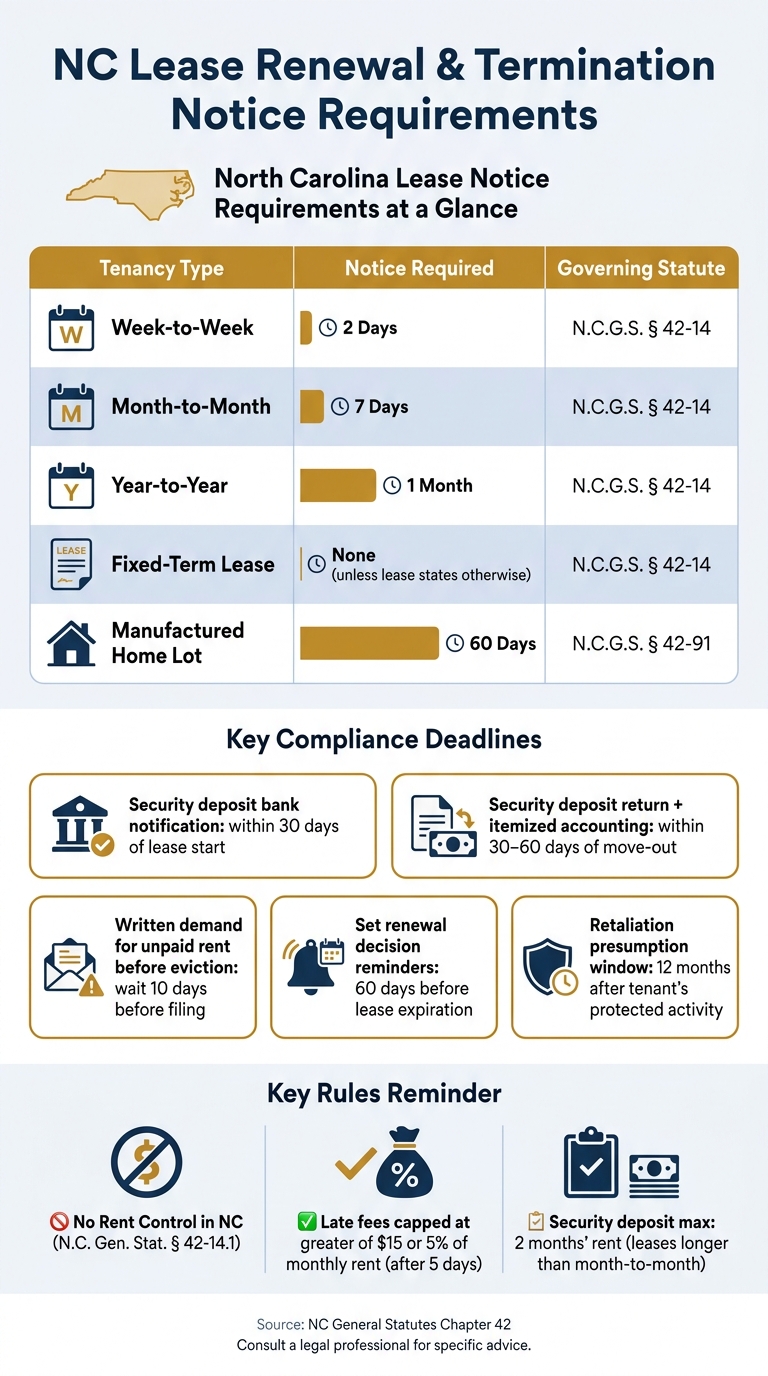
NC Lease Renewal Notice Requirements by Tenancy Type
Giving proper notice is key to avoiding legal headaches. Professional Raleigh property management can help ensure all notices are served correctly and on time. Missing a deadline could mean you’re stuck with a tenant you intended to remove or forced into renewing a lease you no longer want.
Statutory Notice Periods by Tenancy Type
North Carolina’s laws, outlined in N.C.G.S. § 42-14, set minimum notice requirements for different types of tenancies. While landlords can include longer notice periods in their leases, they cannot shorten the statutory minimum. For manufactured home lot rentals, N.C.G.S. § 42-91 imposes a much longer 60-day notice period, which often surprises landlords unfamiliar with this rule.
| Tenancy Type | Statutory Minimum Notice | Relevant Statute |
|---|---|---|
| Week-to-week | 2 days | N.C.G.S. § 42-14 |
| Month-to-month | 7 days | N.C.G.S. § 42-14 |
| Year-to-year | 1 month | N.C.G.S. § 42-14 |
| Fixed-term | None (unless lease states otherwise) | N.C.G.S. § 42-14 |
| Manufactured home lot | 60 days | N.C.G.S. § 42-91 |
One crucial point to remember is that landlords must legally terminate the tenant’s estate before starting an eviction process. This principle, established in Stanley v. Harvey, 90 N.C. App. 535, states:
"Lessor must terminate lessee’s estate before commencing summary ejectment action."
Skipping this step can derail your eviction case altogether.
Best Practices for Sending Renewal and Nonrenewal Notices
While the law provides clear guidelines, going above and beyond the minimum can protect landlords even further. Written notices, for example, are a smart precaution – even when not legally required. They provide a clear record, which can be invaluable in Small Claims Court, where disputes over amounts up to $10,000 are often resolved in North Carolina.
Here are some practical tips:
- Review your lease carefully. It might require more than the statutory minimum notice, such as 30, 45, or even 60 days. It may also specify how notices must be delivered (e.g., certified mail).
- Document everything. Use certified mail with a return receipt or another method that provides proof of delivery. Keep copies of all correspondence.
- Avoid self-help evictions. Actions like changing locks, shutting off utilities, or removing doors to force a tenant out are illegal under N.C.G.S. § 42-25.6.
There are also two key protections landlords should know about. First, N.C.G.S. § 42-37.1 prohibits landlords from refusing to renew a lease as retaliation against tenants who report habitability issues or request repairs. Second, N.C.G.S. § 42-45.1 allows survivors of domestic violence to break a lease early with just 30 days’ written notice and proper documentation. This situation falls outside the usual notice rules.
If a tenant remains on the property after the notice period ends, landlords must file a Summary Ejectment action in District Court. Only a sheriff – not the landlord – has the authority to physically remove a tenant. Following proper notice procedures is essential to avoid the legal pitfalls mentioned earlier.
Automatic Renewal and Holdover Tenancies
When a Lease Automatically Renews
Some leases come with an automatic renewal clause, which means the lease rolls over for another term unless one party gives notice to end it. If your lease has this clause, missing the deadline to notify could lead to an unintentional renewal.
It’s crucial to check the automatic renewal terms in your lease before it expires. The notice period required to opt out might be longer than the legally required minimum. On the other hand, if there’s no automatic renewal clause and the lease simply ends, accepting rent from the tenant could turn the arrangement into a periodic tenancy.
If the lease expires without renewal or proper notice, you’ll need to address any holdover tenancy issues.
How to Handle Holdover Tenants
In addition to automatic renewals, landlords should be ready to deal with tenants who stay beyond the lease term. A holdover tenancy happens when a tenant remains on the property after the lease has ended without the landlord’s consent. In this situation, you have two options: accept rent – creating a month-to-month tenancy – or proceed with eviction.
Be cautious: accepting even a single rent payment from a holdover tenant establishes a month-to-month tenancy. If eviction is necessary, you’ll need to file a Summary Ejectment action under N.C.G.S. § 42-26. Keep in mind that filing fees and hearing schedules may differ depending on the court.
As North Carolina law emphasizes:
"It is the public policy of North Carolina that a residential tenant may only be evicted through the procedure prescribed by Article 3 or Article 7 of Chapter 42." – N.C.G.S. § 42-25.6
Landlords can also pursue unpaid rent and damages for the time the tenant stayed without authorization. However, the statute of limitations to recover this "reasonable compensation" is three years, so it’s important to act quickly.
Updating Lease Terms at Renewal
As a lease nears its expiration date, it’s a great time to revisit and adjust the terms to better suit both parties.
Lease Renewal vs. Lease Extension: What’s the Difference?
A lease renewal involves renegotiating and updating terms, while a lease extension simply continues the current agreement without changes. If you need to modify key provisions – like rent or responsibilities – choose a renewal. Stick with an extension if you’re only looking to extend the lease duration.
Adding Rent Increases and New Terms at Renewal
In North Carolina, landlords have broad freedom to adjust lease terms during renewal. Since the state doesn’t impose rent control (as outlined in N.C. Gen. Stat. § 42-14.1), landlords can increase rent during renewal as long as they provide proper notice.
"At renewal, any terms can be renegotiated including rent, and the new terms become effective when the tenant accepts the renewal." – Mehak, Product Strategist, RIOO
For fixed-term leases, the existing terms stay in place unless changes are agreed upon during renewal. On the other hand, for month-to-month agreements, landlords must give at least 7 days’ notice before the next rent due date to implement changes.
Here are some key considerations when updating lease terms:
- Late fees: These must comply with the legal cap, which is the greater of $15 or 5% of the monthly rent. Late fees can only be charged if the rent is at least 5 calendar days overdue.
- Security deposits: If rent increases, landlords may adjust the deposit accordingly. However, for leases longer than month-to-month, the deposit cannot exceed two months’ rent.
- Retaliation protections: If a tenant recently reported a habitability issue or exercised a legal right, raising rent within 12 months could be seen as retaliatory. To avoid this, document the reasons for any rent increase in writing.
To ensure clarity and enforceability, all changes should be recorded in a signed renewal addendum or a completely new lease agreement.
Compliance Tips for North Carolina Landlords
Staying compliant as a landlord in North Carolina means keeping track of deadlines and maintaining proper documentation.
Tracking Deadlines and Staying on Top of Notices
Your signed lease agreement is your most important tool for compliance. As MoveZen Property Management explains, "Your signed lease controls the renewal timeline, notice rules, fees, and procedures – not state law." In other words, understanding the terms of your lease is step one.
A smart way to stay ahead of deadlines is to set calendar reminders for 60 days before each lease expires. This gives you enough time to decide whether to renew, adjust terms, or start marketing the property. For month-to-month leases, the minimum notice required by law is just 7 days to terminate or change terms. However, that’s a very short timeframe, so planning ahead is crucial.
Additionally, landlords must notify tenants of the bank holding their security deposit within 30 days of the lease’s start. At the end of the lease, the deposit must be returned – or an itemized accounting provided – within 30 to 60 days to avoid legal penalties like treble damages. Always document communications in writing, whether through tenant portals or certified mail, to maintain clear records.
If a tenant’s non-renewal is tied to unpaid rent, you must issue a written demand for the overdue amount and wait 10 days before filing for summary ejectment. Skipping this step could jeopardize your case.
"The property managers who operate well in North Carolina are the ones who understand that the statute’s landlord-friendliness is contingent on following the statute’s procedures correctly. The law rewards discipline. It does not excuse shortcuts." – Mehak, Product Strategist, RIOO
By following these steps, landlords can avoid costly mistakes and ensure smooth operations. For those who find compliance overwhelming, there are services that can help.
How Unicorn Rentals Can Help with Lease Renewals
Managing renewal deadlines, tenant communications, and deposit accounting across multiple properties can be tricky. That’s where Unicorn Rentals comes in. They specialize in helping landlords in Raleigh, Durham, Chapel Hill, and the greater Triangle area.
Unicorn Rentals takes care of the 60-day renewal decision window, handles turnover inspections, and ensures all notices comply with NC Chapter 42’s requirements. Their Tier 3 – Premium plan (15% of monthly rent, or 12% for landlords with 5+ units) includes free lease renewals and preventive maintenance inspections. This reduces the administrative burden and helps landlords avoid missing critical deadlines or paperwork.
For landlords looking for full-service support, Unicorn Rentals offers a practical solution to streamline compliance and property management tasks.
Key Takeaways for NC Landlords
North Carolina’s lease renewal laws are straightforward, but the details matter. Your lease agreement plays a central role in renewal terms, so ensuring clear and precise language is crucial.
Here are some important timelines to keep in mind:
- For month-to-month tenancies, 7 days’ notice is required to terminate or modify the terms.
- Security deposits must be returned, along with a written accounting, within 30 to 60 days of move-out. Missing these deadlines could result in penalties.
North Carolina law gives landlords considerable flexibility. There are no rent control laws, no requirement for just-cause evictions, and no limits on rent increases – as long as proper notice is provided. However, landlords cannot refuse a renewal for discriminatory reasons or retaliate against tenants who exercise their legal rights. Any adverse action taken within 12 months of a tenant’s protected activity is presumed to be retaliatory.
"North Carolina’s landlord-tenant laws are surprisingly simple when it comes to lease renewal. Unlike some states with strict renewal rules, NC laws leave most renewal requirements up to the lease agreement itself." – MoveZen Property Management
These points highlight the importance of drafting leases carefully and staying compliant with North Carolina regulations, or working with property management in Durham to ensure legal accuracy.
FAQs
What lease language should I add to avoid accidental auto-renewal?
To avoid accidental auto-renewal, make sure your lease includes clear language requiring explicit agreement for renewal. For instance: "This lease shall not automatically renew. Any renewal or extension must be agreed upon in writing by both parties prior to the expiration date." This approach ensures both the landlord and tenant are fully aware that the lease won’t renew automatically and that active consent is necessary for any extension.
What’s the safest way to prove my renewal or nonrenewal notice was delivered?
The best way to ensure your renewal or nonrenewal notice is delivered securely is by using certified mail with a return receipt requested. This method provides a clear record of delivery. Additionally, make sure to keep both a copy of the notice and the receipt as proof for your records.
If a tenant won’t leave after the lease ends, what should I do first?
Under North Carolina law, if a tenant stays beyond the end of their lease, the first step is to provide them with a notice to quit. For year-to-year leases, this notice must be delivered at least one month before the current lease year ends. This notice serves as a formal warning, informing the tenant that they need to vacate the property before you can proceed with any legal action.