

In North Carolina, managing tenant deposits is governed by the Tenant Security Deposit Act (N.C.G.S. § 42-50 to § 42-56), which applies exclusively to residential leases. Here’s what you need to know:
- Deposit Limits: The maximum deposit depends on the lease term:
- Week-to-week: 2 weeks’ rent
- Month-to-month: 1.5 months’ rent
- Longer leases: 2 months’ rent
- Handling Funds: Deposits must be kept in a trust account at a licensed, federally insured NC bank, or secured by a surety bond (not available to brokers).
- Tenant Notification: Landlords must notify tenants within 30 days of where the deposit is held.
- Allowed Deductions: Only for unpaid rent, damages beyond normal wear and tear, or other specific costs (e.g., re-renting fees). Routine cleaning or wear and tear cannot be deducted.
- Returning Deposits: Refund or itemized deductions must be provided within 30 days of move-out. If costs are pending, an interim notice can extend this to 60 days.
Failure to comply with these rules can lead to forfeiting the deposit, treble damages, and legal fees. Proper documentation, including photos and detailed records, is critical to protect both landlords and tenants.
For landlords managing multiple properties, staying compliant with these regulations is key to avoiding costly disputes and evictions.
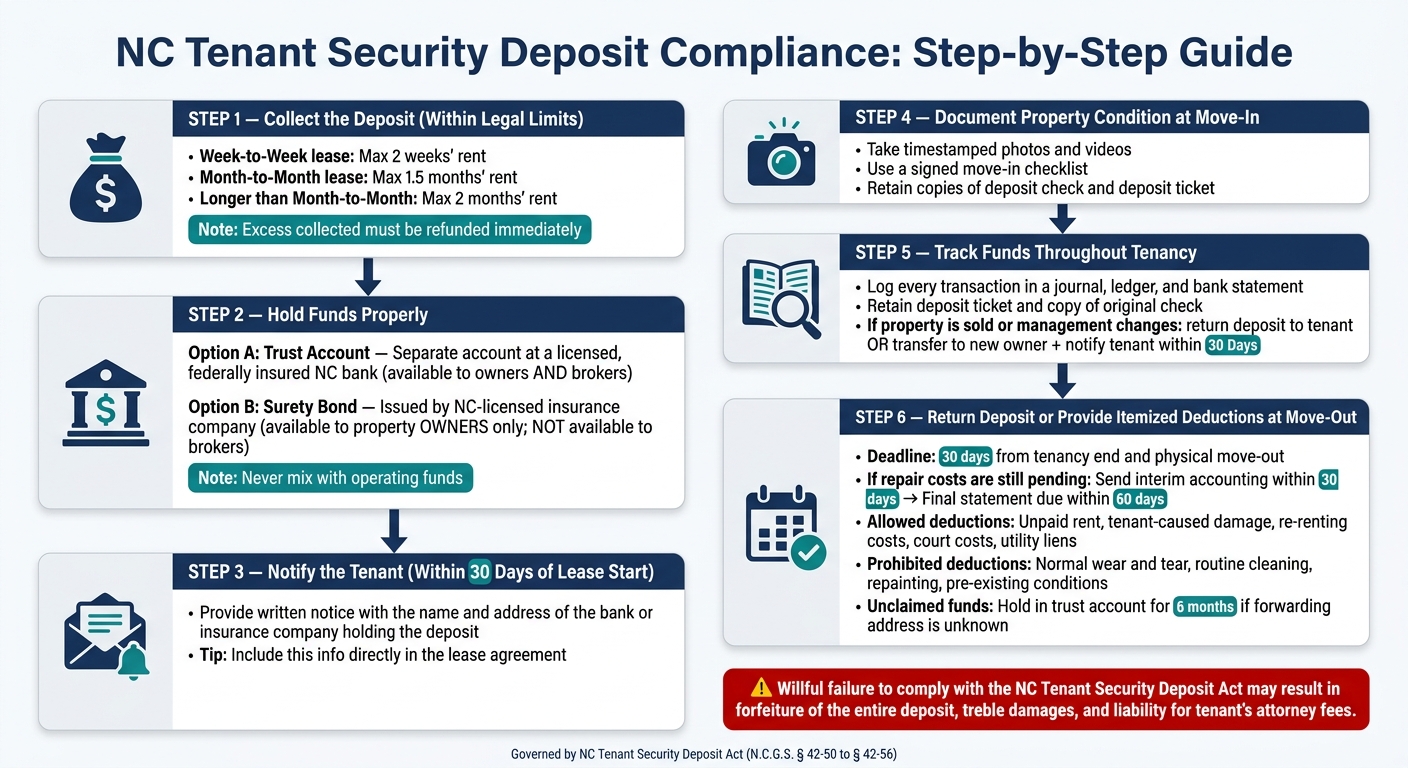
NC Tenant Security Deposit Compliance: Step-by-Step Guide
North Carolina Security Deposit Laws for Landlords and Tenants
sbb-itb-aa27f6d
North Carolina Security Deposit Limits
In North Carolina, property managers must adhere to strict limits on security deposits. These limits are non-negotiable and take precedence over any conflicting lease terms.
"A landlord who collects more than the statutory maximum has violated the Act regardless of what the lease says. A lease provision authorizing a security deposit above the statutory cap is unenforceable." – Mehak, Product Strategist, RIOO
Deposit Limits by Lease Term
The maximum security deposit allowed depends on the lease term:
| Lease Term | Maximum Allowable Security Deposit |
|---|---|
| Week-to-Week | 2 weeks’ rent |
| Month-to-Month | 1.5 months’ rent |
| Longer than Month-to-Month | 2 months’ rent |
According to N.C. Gen. Stat. § 42-51(b): "The security deposit shall not exceed an amount equal to two weeks’ rent if a tenancy is week to week, one and one-half months’ rent if a tenancy is month to month, and two months’ rent for terms greater than month to month."
If a landlord collects more than these limits, the excess must be refunded immediately. Failing to comply forfeits the right to use those funds for damage claims.
Pet fees are a special case. A non-refundable pet fee is allowed but must be clearly labeled as such in the lease. If labeled as a "refundable pet deposit", it becomes part of the security deposit and counts toward the legal cap. These rules apply only to standard residential leases.
Applicability to Residential Properties
The Tenant Security Deposit Act applies exclusively to residential rental agreements in North Carolina. Commercial leases are exempt, as their deposit terms are governed by the lease contract.
There is, however, an exception for residential properties: single rooms rented on a weekly, monthly, or annual basis. These are not subject to the Act’s requirements. If you’re managing properties in this category, the statutory caps and rules don’t apply. However, consulting a local attorney is wise to confirm whether this exemption applies to your situation. Understanding these rules is essential for managing tenant deposits effectively under North Carolina law.
How to Properly Hold Tenant Deposits
Once you’ve collected a security deposit that meets legal requirements, North Carolina law lays out strict guidelines for how and where you must store those funds. Failing to follow these rules could mean losing the right to make deductions from the deposit.
"The ‘willful failure’ of the landlord to comply with the Act results in the landlord forfeiting their claim to any portion of the security deposit." – Peter Isakoff, Attorney, The Law Offices of Peter Isakoff
Trust Account and Banking Requirements
Under N.C. Gen. Stat. § 42-50, landlords must follow specific rules for handling tenant deposits:
"Security deposits from the tenant in residential dwelling units shall be deposited in a trust account with a licensed and federally insured depository institution or a trust institution authorized to do business in this State."
This means the funds must be kept in a separate trust account at a bank licensed in North Carolina. Mixing these funds with operating accounts is not allowed. The deposit remains the tenant’s property until the lease ends and any deductions are approved. Using the funds for other purposes during the lease is strictly prohibited.
While the law does not require trust accounts to earn interest, they can if both the landlord and tenant agree.
Using a Bond as an Alternative
If opening a trust account isn’t ideal, landlords can opt for a surety bond instead. This bond must be issued by an insurance company licensed in North Carolina and must cover the full amount of the deposits held.
However, there’s a key restriction: licensed real estate brokers cannot use this option. Brokers are required to use trust accounts. For property owners, obtaining a surety bond for individual deposits may also prove difficult.
"This option [Bond] is NOT available to real estate brokers. If you are an owner, you may encounter difficulty finding an insurance company willing to issue such a bond." – North Carolina Real Estate Commission
Here’s a quick comparison of the two options:
| Feature | Trust Account | Surety Bond |
|---|---|---|
| Who can use it | Owners and licensed brokers | Property owners only |
| Provider | Licensed, federally insured NC bank | NC-licensed insurance company |
| Tenant notification | Bank name and address | Insurance company name |
| Notification deadline | Within 30 days of lease start | Within 30 days of lease start |
Once you decide how to hold the funds, accurate recordkeeping and timely tenant notification are essential to staying compliant.
Recordkeeping and Tenant Notification
After securing the deposit, it’s important to keep detailed records and notify tenants promptly. You must inform tenants of the bank or insurer holding their deposit within 30 days of the lease start. Including this information in the lease agreement is a straightforward way to meet this requirement.
For recordkeeping, document every deposit check in a journal and a property transaction ledger, and ensure it appears on your bank statement. Retain copies of the deposit ticket and the original check for your records. If you sell the property or transfer management to a Raleigh property manager, you must either return the deposit to the tenant or transfer it to the new owner. In either case, notify the tenant of the new deposit location within 30 days of the transfer.
Allowed and Prohibited Uses of Tenant Deposits
Knowing what deductions are allowed and which are not is essential for staying compliant with North Carolina law. According to North Carolina General Statute § 42-51, there are eight specific reasons landlords can legally withhold tenant deposits. If a reason isn’t on that list, it’s not permitted – no exceptions.
Allowed Deductions
Landlords can deduct for unpaid rent and utility bills (like water, sewer, and electricity) that have become liens against the property. Deductions are also allowed for tenant-caused physical damage, including harm to essential safety devices. If a tenant breaks the lease early, landlords may deduct re-renting costs, such as reasonable commissions paid to a licensed real estate broker, court costs, and expenses for removing and storing belongings after an eviction.
However, there are exceptions. If a tenant ends the lease early due to domestic violence or active military service, landlords cannot deduct lease-breaking costs.
On the flip side, deductions for normal property use are strictly off-limits.
Prohibited Deductions
Landlords cannot deduct for normal wear and tear, which refers to the natural aging of a property from everyday use.
"You may deduct from the deposit only for actual damage the tenant caused. Do not deduct for ordinary wear and tear." – North Carolina Real Estate Commission
Routine cleaning, carpet cleaning between tenants, and repainting are also prohibited unless the property is left in extreme disarray requiring significant restoration. Additionally, landlords cannot charge for pre-existing conditions or bill tenants for the full replacement cost of an item when a repair would suffice.
Here’s a quick breakdown of what’s allowed versus what’s not:
| Normal Wear and Tear (Prohibited) | Excessive Damage (Permitted) |
|---|---|
| Small nail holes from hanging pictures | Large holes in walls or crayon marks |
| Faded or peeling paint from age | Unauthorized paint colors or graffiti |
| Worn carpeting from regular foot traffic | Burned spots, heavy stains, or pet damage to carpet |
| Leaking faucets or worn lavatory basins | Broken windows or cracked countertops |
| Routine dust and light soil | Extreme filth requiring extraordinary cleaning |
To protect yourself and ensure fairness, always document the property’s condition at both move-in and move-out. Photos or videos are your best tools for distinguishing between normal wear and tear and excessive damage, as well as justifying any deductions.
Returning Deposits and Providing Itemized Statements
When a tenant moves out, landlords in North Carolina are legally required to either return the security deposit, provide a written itemized statement of deductions, or both. This ensures transparency and compliance with state regulations.
The 30-Day Return Deadline
Landlords must complete this process within 30 days from the end of the tenancy and the tenant’s physical move-out date. The clock starts ticking once the lease ends and the tenant returns the keys – so it’s essential to document the key return date. As Peter Isakoff, Attorney at The Law Offices of Peter Isakoff, explains:
"The ‘willful failure’ of the landlord to comply with the Act results in the landlord forfeiting their claim to any portion of the security deposit."
When Extra Time Is Allowed
If some repair costs are still pending, landlords can send an interim accounting within the first 30 days, which allows for an extended deadline of up to 60 days for the final statement. This interim notice must clearly outline the damages already identified and include a statement that a final accounting will follow. Labeling this as an "Interim Accounting" is critical – if it’s mistaken for a final statement, the 60-day extension is forfeited.
"If the total damage cannot be determined within 30 days, send: 1. An interim accounting within 30 days, and 2. A final accounting no later than 60 days after tenancy ends." – North Carolina Real Estate Commission
This two-step process ensures landlords can meet their obligations while waiting for final repair costs.
How to Write an Itemized Statement
An itemized statement must list each deduction clearly and include specific dollar amounts. For example, instead of vague terms like "property damage", specify details such as "repair of broken bedroom window – $185" or "unpaid water bill – $62." Savannah Minnery from iPropertyManagement emphasizes:
"North Carolina requires landlords to give tenants an itemized written list that explains every deduction taken from the security deposit."
The statement and any remaining deposit funds must be mailed or hand-delivered to the tenant’s last known address. While attaching invoices or receipts isn’t legally required, doing so can help avoid disputes or small claims lawsuits – which can involve claims up to $10,000. If the tenant’s forwarding address is unknown, landlords must hold the unclaimed funds in a trust account for six months to remain compliant. Proper documentation throughout this process is key to adhering to North Carolina law.
| Requirement | Deadline | Notes |
|---|---|---|
| Return deposit or final itemized statement | 30 days | From tenancy end and move-out |
| Interim accounting (if costs are unknown) | 30 days | Required to unlock the 60-day extension |
| Final itemized statement | 60 days | Provided if final costs cannot be determined by day 30 |
| Hold unclaimed funds | 6 months | If the tenant’s forwarding address is unknown |
For landlords or property managers looking for professional help with managing security deposits and ensuring compliance, Unicorn Rentals offers tailored property management services. Learn more at Unicorn Rentals.
Deposit Compliance Checklist for Property Managers
Navigating North Carolina’s deposit regulations boils down to three key tasks: collecting and documenting deposits accurately, managing funds appropriately, and keeping track of them until the tenant moves out.
Deposit Collection and Documentation
First, ensure the deposit amount adheres to state limits and that the lease agreement clearly spells out the terms. This includes outlining when deductions might apply.
Document the property’s condition at move-in. Use photos, videos, and a signed checklist to create a reliable record. Within 30 days of the lease start date, provide tenants with written notice that includes the bank’s name and address where their deposit is being held.
"Within 30 days after the lease begins, landlords/property managers must notify the tenant of the name and address of the bank/institution where the security deposit is held or the name of the insurance company providing the bond." – Obligo
Once everything is documented, make sure the funds are placed according to state requirements.
Placing Funds Correctly
Deposits must be kept in a dedicated trust account at a federally insured bank or institution within North Carolina. Real estate brokers are required to use a trust account exclusively, as they cannot opt for a bond. However, individual property owners may choose to secure a surety bond through a North Carolina-licensed insurance provider, as outlined above.
Tracking and Returning Deposits
After placing the funds, maintain detailed records throughout the tenancy. Every deposit transaction should be logged in a journal, ledger, and bank statement. Keep supporting documents like the deposit ticket and a copy of the check.
"A tenant security deposit check should be noted in a journal, a property transaction ledger, and a bank statement, and the bank deposit ticket and a copy of the deposit check should be retained." – North Carolina Real Estate Commission
When it comes to deductions, only charge for damages that go beyond normal wear and tear:
"The landlord is only permitted to keep that portion of the security deposit necessary to cover the actual allowable costs." – Coltrane Grubbs & Orenstein
If the property is sold or changes management, the original landlord must either return the deposit to the tenant (minus any lawful deductions) or transfer it to the new owner. Written notification of this transfer must be given to the tenant within 30 days.
Key Takeaways
Following North Carolina’s tenant deposit regulations isn’t just a good practice – it’s essential for staying compliant. The state’s deposit rules are strict, and a "willful failure" to adhere to the Tenant Security Deposit Act could mean losing your right to keep any part of the deposit. Worse, you might also be responsible for covering the tenant’s attorney fees.
Here are the main points to keep in mind:
- Collect only the deposit amounts permitted by law.
- Use a proper trust account or bond to hold the deposit.
- Notify tenants within 30 days of where their deposit is held.
- Return deposits or provide an itemized list of deductions within 30 days (or 60 days if you need interim accounting).
Good documentation can save you. Timestamped photos and signed checklists are invaluable tools. They help justify deductions and protect you if disputes arise. Remember, you can only deduct for damages that go beyond normal wear and tear.
If you manage multiple properties in the Triangle area, staying on top of deadlines and maintaining separate trust accounts can get overwhelming. This is where a property management company like Unicorn Rentals can make all the difference. They can streamline these processes from day one, ensuring compliance is built into your workflow. For those with complex portfolios, working with a professional like Unicorn Rentals can help you handle these responsibilities without added stress.
FAQs
When does the 30-day deadline to return the deposit start?
In North Carolina, landlords have 30 days after the tenancy ends and the tenant returns possession of the property to address the security deposit. During this time, they must either refund the entire deposit or provide a written, itemized list of deductions. If repairs are still pending, landlords must send an interim accounting within the 30-day window, followed by a final accounting no later than 60 days.
What’s the safest way to prove damages vs. normal wear and tear?
The most effective way to differentiate between damages and normal wear and tear is by thoroughly documenting the property’s condition. Start with detailed move-in and move-out inspections, using a checklist that both you and the tenant sign. To make things even clearer, include dated photos or videos as visual proof. If you need to make deductions, ensure you provide an itemized written statement within the required 30-day (or 60-day) timeframe. Attach invoices, receipts, or cost estimates to maintain clarity and stay compliant.
What happens to deposits if the property is sold or management changes?
When a property is sold or changes hands, the previous landlord or property manager has 30 days to handle the tenant’s security deposit. They have two options: either return the deposit (minus any lawful deductions) or transfer it to the new owner or manager. If the deposit is transferred, the tenant must be notified in writing via mail. This notice should include the name and address of the new owner or manager.