
Navigating the eviction process in Wake County means following North Carolina’s strict legal requirements. Here’s what you need to know:
- Eviction Basics: Known as "summary ejectment", evictions must follow state laws, including proper notice and court filings. Self-help evictions, like changing locks or cutting utilities, are illegal.
- Reasons for Eviction: These include nonpayment of rent, lease violations, holdover tenancy, or criminal activity. Retaliatory evictions or actions against protected tenants (e.g., domestic violence survivors) are prohibited.
- Notice Periods: Notice requirements depend on tenancy type, ranging from 2 days (week-to-week) to 60 days (mobile home lots).
- Court Process: File a summary ejectment complaint in Small Claims Court, where a magistrate hears the case. Either party can appeal within 10 days.
- Final Steps: If the landlord wins and no appeal is filed, the sheriff enforces the eviction via a Writ of Possession.
Key Tip: Missing any step or deadline can delay the process or result in dismissal. Legal or professional help is highly recommended to avoid procedural mistakes. Services like Unicorn Rentals can manage notices, filings, and tenant communications for landlords.
For landlords, preparation is critical. Gather all documentation, follow notice rules, and consult experts to ensure compliance.
Legal Grounds and Notice Requirements for Eviction
Valid Reasons for Eviction
In Wake County, there are four main reasons a landlord can evict a tenant:
- Nonpayment of rent: If a tenant fails to pay rent on time, landlords can file for summary ejectment.
- Holdover tenancy: This applies when a tenant stays beyond their lease expiration without renewing.
- Lease violations: These include issues like unauthorized pets, unapproved occupants, or other breaches of the lease agreement.
- Criminal activity: Engaging in illegal activities is also grounds for eviction under North Carolina law.
"The General Assembly recognizes that the residents of this State have the right to the peaceful, safe, and quiet enjoyment of their homes." – North Carolina General Statutes
However, landlords cannot evict tenants as retaliation for reporting code violations or because they are survivors of domestic violence, sexual assault, or stalking.
Once you’ve determined that you have valid grounds, it’s crucial to follow the proper notice procedures.
Required Notices Before Filing
Before initiating an eviction case, landlords must provide tenants with written notice. The notice period depends on the type of tenancy:
| Tenancy Type | Required Notice Period |
|---|---|
| Week-to-week | 2 days |
| Month-to-month | 7 days |
| Year-to-year | 1 month |
| Manufactured/mobile home lot | 60 days |
In Wake County, most residential leases are either month-to-month or year-to-year, meaning the notice period will typically be 7 days or 1 month. Providing the wrong notice period can result in your case being dismissed, so confirm the tenancy type before drafting the notice. Professional property managers often oversee these requirements across the various cities we serve to ensure compliance.
If the notice period expires without resolution, you can move forward with filing your complaint.
Wake County-Specific Filing Notes
After the notice period ends and the tenant hasn’t resolved the issue, you can file a summary ejectment complaint at the Wake County Courthouse. The case will be handled by a civil Magistrate in Small Claims Court, which oversees disputes involving rent and security deposits up to $10,000.
Here are some key filing costs to keep in mind:
- If the tenant pays the full amount after filing but before judgment, you can collect a complaint fee of either $15 or 5% of the monthly rent (whichever is greater).
- If you win the case without an appeal, you’re entitled to a court appearance fee of 10% of the monthly rent. If the case is appealed and you win, a second trial fee of 12% applies.
For landlords renting to Section 8 tenants, any percentage-based fees must be calculated on the tenant’s portion of the rent, not the full subsidy amount.
sbb-itb-aa27f6d
Your Guide to The Eviction Process in North Carolina
Step-by-Step Eviction Timeline in Wake County
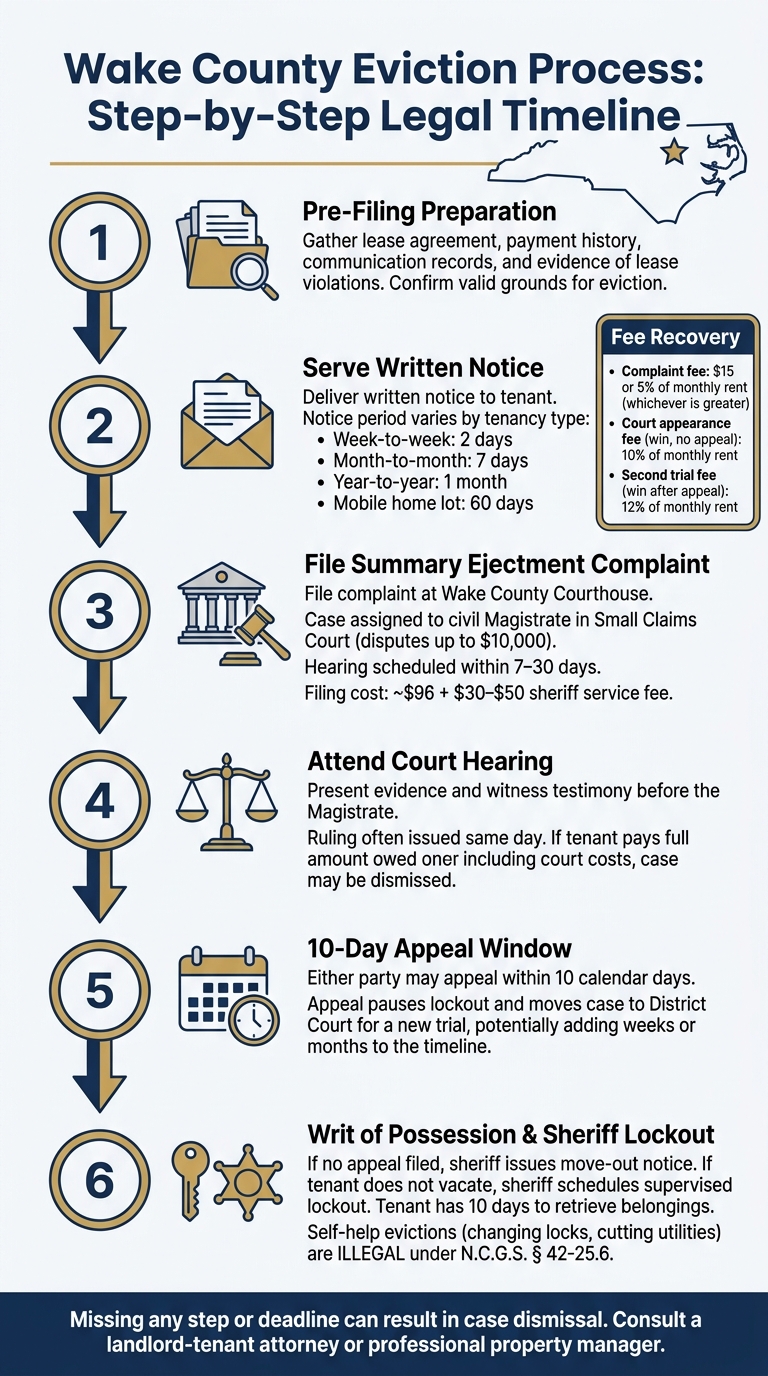
Wake County Eviction Process: Step-by-Step Legal Timeline
Understanding the process from start to finish is crucial to avoid missteps and keep things on track without unnecessary delays.
Pre-Filing Preparation
Before filing, gather all necessary paperwork, including the lease agreement, payment history, communication records, and any evidence of lease violations. Double-check that your eviction grounds and the notice provided meet all legal requirements. Missing or incomplete documentation can lead to case dismissal. Once everything is in order, you’re ready to move forward with filing.
Filing an Eviction Case
To begin the legal process, file a summary ejectment complaint at the Wake County Courthouse. After filing, the court issues a summons to inform the tenant of the hearing date and time. Make sure the summons is served legally. The case will then be assigned to a civil Magistrate in Small Claims Court.
Hearing and Judgment
At the hearing, both you and the tenant will present your evidence. Be sure to bring all relevant documents and any witness testimony. Decisions are often made on the spot, but keep in mind that if the tenant pays the full amount owed, including court costs, they could win the case. After the hearing, there’s a 10-day window during which either party can file an appeal.
Writ of Possession and Lockout
If no appeal is filed within 10 days of a favorable ruling, the sheriff will issue a move-out notice to the tenant. Should the tenant fail to leave, a supervised lockout will be scheduled – note that self-help evictions are against the law. Once the lockout occurs, the tenant has 10 days to retrieve their belongings. After this period, you can clear the unit, document damages, and send a notice about any deductions from the security deposit.
Appeals, Tenant Defenses, and Risk Management
How the Appeals Process Works
If either party wants to challenge a Magistrate’s ruling, they must file an appeal within 10 calendar days of the decision. Filing an appeal pauses the lockout process, effectively delaying the eviction’s final resolution. Once appealed, the case moves to District Court for a completely new trial – not just a review of the earlier hearing. This process can stretch the timeline by weeks or even months, so landlords should be prepared both financially and logistically. Additionally, if the lease allows and the landlord wins in District Court, a 12% second trial fee may be added. Understanding these steps is crucial, as tenants often use defenses to prolong eviction proceedings.
Common Tenant Defenses
Tenants have several defenses they can use to complicate or delay the eviction process. One of the simplest is the tender of rent defense. In this case, tenants bring the full amount owed – including court costs – to the hearing, which could result in the case being dismissed.
Another frequent defense involves habitability issues. Under North Carolina law, landlords are required to provide safe and livable conditions, and this obligation is tied to the tenant’s duty to pay rent. If repairs are neglected, tenants may use this as a defense or even request a rent rebate.
Other defenses include procedural errors, like improper notice or incorrect notice periods, as well as claims of retaliatory eviction. Additionally, tenants who are victims of domestic violence or stalking are protected by law, and landlords cannot evict or retaliate against them on these grounds.
Steps to Reduce Eviction Risks
The best way to avoid eviction disputes is to take proactive steps and best practices to prevent them. Clear lease agreements, thorough tenant screening, and detailed maintenance records can significantly reduce the chances of conflicts. Brandon Davis, a Real Estate Investment Consultant at Henderson Properties, emphasizes the importance of preparation:
"The safest way to approach 2026 is with a quick internal audit. Review your lease templates, insurance clauses, deposit procedures, maintenance workflows, renewal processes, and technology tools."
To further reduce risks, ensure that late fees and security deposit handling comply with state laws. Keep written records of all maintenance requests and repairs. For landlords who want professional assistance, Unicorn Rentals provides full property management services in Raleigh, Durham, Chapel Hill, and across the Triangle area. Partnering with experienced legal or property management professionals can streamline the eviction process and strengthen risk management strategies.
Local Resources and Professional Support
Wake County Courts and Sheriff’s Civil Process Unit
If you’re dealing with a Summary Ejectment complaint, you’ll need to file it with the Wake County clerk of court. After filing, hearings are scheduled within 7–30 days. Court staff can guide you to the right filing window to get started.
Once the case is filed, the Sheriff’s Civil Process Unit will serve the summons, including details about the hearing. If the court rules in your favor, only the sheriff is authorized to carry out a Writ of Possession and formally remove the tenant. Keep in mind, attempting a self-help eviction – like changing locks or cutting off utilities – is illegal under N.C.G.S. § 42-25.6.
For smaller disputes, such as disagreements over security deposits, Small Claims Court can handle claims up to $10,000. Additionally, you can reach out to Wake County’s Housing and Community Development Department at 919-996-4330 for assistance with local housing regulations.
Alongside these court procedures, nonprofit organizations and legal aid services are available to provide further support.
Legal Aid and Nonprofit Resources
Legal aid and nonprofit groups can be a great resource for understanding landlord-tenant laws in North Carolina. Legal Aid of North Carolina, for instance, offers helpful information on the North Carolina Residential Rental Agreements Act (N.C.G.S. Chapter 42). While their primary focus is on assisting low-income tenants, landlords can also benefit from their educational materials to better understand tenant rights and responsibilities.
If you need legal representation, consider reaching out to attorneys who specialize in landlord-tenant law. These professionals are regulated by the North Carolina State Bar, ensuring proper oversight. Similarly, property managers are licensed through the North Carolina Real Estate Commission (NCREC). Consulting with these experts can provide extra assurance and help you navigate complex situations.
How Unicorn Rentals Supports Landlords

Managing evictions can be overwhelming, with all the paperwork, tenant communication, and property turnover involved. That’s where professional property management services, like Unicorn Rentals, can step in to help.
Unicorn Rentals offers comprehensive property management services across Raleigh, Durham, Chapel Hill, and the Triangle area. Their Value+ plan, priced at 13% of monthly rent (or 10% for landlords with five or more units), includes benefits like an Eviction Guarantee, Loss of Rent Guarantee, and Malicious Damage Coverage. For those seeking even more support, the Premium plan (15% of monthly rent) adds perks like free lease renewals, reduced tenant placement fees, and preventive maintenance inspections to help avoid issues that might lead to evictions.
Unicorn Rentals takes care of essential tasks such as delivering required notices, managing documentation, and coordinating property turnover. This ensures that all records are accurate and timelines are followed, giving landlords peace of mind throughout the process.
Conclusion
Navigating the eviction process in Wake County requires careful attention to every detail. From delivering the correct notice to respecting the 10-day appeal period after the Magistrate’s ruling, every step must be followed precisely. Missing a step – or resorting to improper eviction methods – can lead to lawsuits, which may include liability for actual damages, court costs, and attorney fees.
The costs involved are also worth noting. Filing a complaint typically costs around $96, with an additional $30–$50 for sheriff service. If you win the case, you might recover fees of 10% or 12% of the monthly rent.
Thorough documentation plays a critical role in this process. Keeping a detailed rent ledger, maintaining written communication logs, and collecting clear evidence of lease violations are key to building a solid case. Similarly, handling security deposits requires precision – landlords have 30 days to either return the deposit or provide an itemized list of deductions. Beyond keeping accurate records, seeking expert assistance can offer an added layer of protection.
Professional support, such as guidance from a landlord-tenant attorney or a specialized property management service like Unicorn Rentals, helps reduce the risk of procedural missteps. Their Value+ and Premium plans include features like an Eviction Guarantee and Loss of Rent Guarantee, providing financial protection if tenant issues arise.
"Understanding the nuances of North Carolina eviction laws is essential to managing the eviction process effectively and lawfully." – David Bitton, Co-founder, DoorLoop
FAQs
What counts as “proper service” of an eviction notice or summons in Wake County?
In Wake County, serving an eviction notice or summons must follow specific guidelines. The documents can be delivered directly to the defendant, sent via mail to their last known address, or posted at their residence with a copy mailed afterward. To meet legal standards, this process must be carried out by a sheriff or an authorized officer.
How can a tenant’s appeal or paying rent at the hearing affect the eviction timeline?
When a tenant files an appeal or makes a payment during the hearing, it can delay the eviction process. By submitting an appeal within 10 calendar days and posting a rent bond, tenants can temporarily halt the lockout, allowing them to stay in the property while the appeal is reviewed. This action can push the eviction timeline beyond the original court ruling.
When should I involve a landlord-tenant attorney or Unicorn Rentals during an eviction?
If you’re dealing with legal concerns like wrongful eviction, landlord violations, or need representation in court, connecting with a landlord-tenant attorney or Unicorn Rentals can make a big difference. They can provide clarity on your rights, offer legal advice, and assist in building your defense. It’s wise to act quickly if you receive an eviction notice or court summons. Early action allows you to explore your options, file necessary claims, or challenge the eviction to safeguard your rights every step of the way.