
In Raleigh-Durham, most landlords pay more than the listed monthly rate. I’d expect 8%–12% of collected rent for monthly management, plus 50%–100% of one month’s rent for leasing, with extra costs for renewals, inspections, maintenance markups, vacancy, setup, and eviction handling.
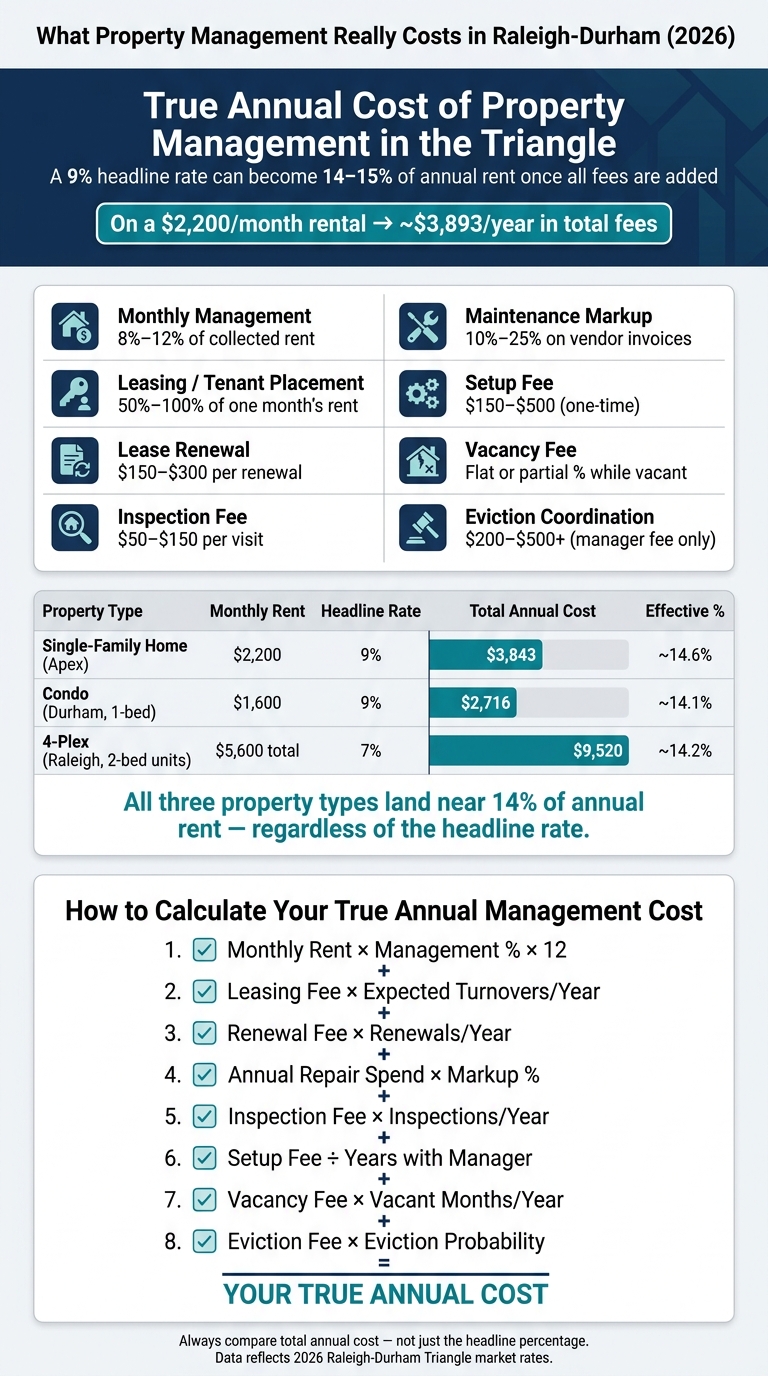
If I were comparing managers in the Triangle, I would not stop at the headline fee. A 9% management rate can turn into an effective annual cost near 14%–15% of rent once I add turnover, repair markups, and admin fees. On a $2,200/month rental, that can mean about $3,800 to $3,900 per year, not just the base monthly charge.
Here’s the short version:
- Monthly management: usually 8%–12%
- Leasing / tenant placement: usually 50%–100% of one month’s rent
- Lease renewals: often $150–$300
- Inspections: often $50–$150 per visit
- Maintenance markups: often 10%–25% on vendor invoices
- Setup fees: often $150–$500
- Vacancy fees: may still apply even when no rent is coming in
- Eviction coordination: often $200–$500+, not including legal costs
The main point: if you want a fair comparison, add every fee into one yearly total. That gives you a much clearer view of what you may pay for a single-family home, condo, townhome, or small multifamily property in Raleigh, Durham, Cary, Chapel Hill, or Apex.
| Cost area | Common 2026 range in the Triangle | What to watch |
|---|---|---|
| Monthly management | 8%–12% | Minimum monthly fees can push the true rate higher |
| Leasing fee | 50%–100% of one month’s rent | Charged each time a unit turns over |
| Renewal fee | $150–$300 | Sometimes charged every year |
| Inspection fee | $50–$150 | Move-in, move-out, and annual checks may all be separate |
| Maintenance markup | 10%–25% | Added on top of repair bills |
| Setup / vacancy / eviction | Varies | These are often missed in early quotes |
I wrote this breakdown to help you check the full cost, spot fee traps, and compare quotes side by side without guessing.
Raleigh-Durham Property Management Fees: True Annual Cost Breakdown (2026)
Common Property Management Fees in Raleigh-Durham and the Triangle
Beyond the headline management and leasing fees, these recurring charges shape what you actually pay over a full year.
Monthly management fees: percentage plans, flat fees, and minimums
Most property managers in the Triangle charge 8%–12% of collected rent, but the fine print on minimums can change the math fast. This hits hardest on lower-rent homes.
For example, a company may quote 8%, which sounds simple enough. But if it also requires a minimum of $125–$175 per month, a $1,300 condo at 8% would come out to $104. That means the minimum kicks in, and your effective rate ends up higher than the quoted one.
On a $2,200/month rental at 9%, the monthly management fee works out to about $198 per month, or roughly $2,376 per year before anything else gets added.
Some companies charge a flat monthly fee instead of a percentage. That can work better for higher-rent properties. On lower-rent condos, though, it can be a tougher deal.
Leasing and tenant placement fees when a property turns over
Leasing fees usually land between 50% and 100% of one month’s rent, or about $750–$1,500 as a flat charge. In most cases, that fee covers marketing, listing syndication, showings, tenant screening, lease preparation, and move-in coordination (part of a broader strategy for avoiding eviction in NC). Some firms also set minimums of $500 or more when they use flat-fee pricing.
If you own a 2–4 unit property, this is where costs can pile up in a hurry. When more than one unit turns over at the same time, managers usually charge a separate leasing fee for each unit instead of bundling them into one amount.
Renewal, inspection, and basic admin charges
Smaller line items can add up too. Lease renewal fees in the Triangle often run $150–$300 per renewal. Inspection fees usually fall between $50 and $150 per visit for move-in, move-out, and interior condition checks.
It’s smart to ask one plain question here: what’s actually included? Some firms include photos, repair notes, and follow-up reports in the inspection charge. Others bill those items on top.
| Fee Type | Typical Triangle Range | Notes |
|---|---|---|
| Monthly management | 8%–12% of collected rent | Most quotes cluster around 8%–10% for single-family homes and small portfolios |
| Leasing / placement | 50%–100% of one month’s rent | Flat fees of $750–$1,500 are also used, often with $500+ minimums |
| Lease renewal | $150–$300 per renewal | Some firms charge a percentage of rent instead |
| Inspection | $50–$150 per visit | Move-in, move-out, annual condition checks |
The biggest jumps in cost usually come from maintenance markups, make-ready work, and vacancy-related charges.
sbb-itb-aa27f6d
Hidden Fees That Raise Your Real Annual Cost
After the base management and leasing fees, these add-ons usually decide what you actually pay over a full year.
Maintenance markups, vendor coordination, and turnover charges
A lot of Triangle property managers don’t list a separate maintenance fee. Instead, they tack a markup onto the vendor’s invoice. Across the Triangle, that markup usually falls between 10% and 25% of the repair cost. So if a plumber charges $400, your bill may end up at $440 to $500 once the markup is added.
That can add up fast. If your property needs $2,000 in annual repairs, a 10% markup adds $200, while a 20% markup adds $400 to your yearly cost. And yes, that’s before you factor in the base management fee you’re already paying.
Turnover work is often where owners get hit harder. Say a tenant moves out and the home needs painting, carpet cleaning, and small repairs totaling $1,500. If the manager charges a 10% coordination fee, your total becomes $1,650. At 15%, it goes to $1,725. Some firms use a flat charge instead, usually $50 to $75 per vendor invoice. So if there are four separate work orders and each carries a $75 fee, that’s $300 in coordination charges on top of the repair bill itself.
Before you sign, check the Maintenance and Repairs section, the Fees and Compensation section, or any attached fee schedule. Terms like maintenance markup, coordination fee, and vendor management fee are the ones to watch for. If the markup is above 20%, that’s worth pushing back on.
The next set of costs shows up before move-in, during vacancy, and if a tenant defaults.
Setup, vacancy, and eviction-related fees
Setup fees are common in the Triangle. They usually run $150 to $500 per property. Some firms collect this upfront. Others take it out of the first month’s rent. One Chapel Hill-area manager, for example, charges a $250 setup fee when the property is already rented when the agreement is signed. In most cases, this covers account setup, payment routing, and tax records.
Vacancy policies are all over the map. Some managers stop charging a management fee when the property is vacant. Others keep charging a full fee or a reduced one even when no rent is coming in. At $1,850 monthly rent, an 8% to 9% vacancy fee works out to $148 to $167 per month.
Eviction coordination fees are separate from court and attorney costs. In the Triangle, managers usually charge $200 to $500+ for handling their part of the process. Filing fees and legal bills are passed through at cost. So when you spot an eviction fee in a contract, check what it actually covers. The manager’s admin work and the legal bill are not the same thing.
| Fee Type | Typical 2026 Triangle Range | Key Detail |
|---|---|---|
| Setup | $150–$500 | One-time per property; sometimes deducted from first month’s rent |
| Maintenance markup | 10%–25% of repair cost | Added to vendor invoices; often listed in the Maintenance and Repairs or Fees and Compensation sections |
| Coordination / project management | 5%–15% of project cost, or $50–$75/invoice | Applies to turnover work |
| Vacancy fee | Flat fee or full/partial % of rent | Charged monthly while vacant; policies vary a lot |
| Eviction coordination | $200–$500+ | Manager’s fee only; court and filing costs are extra |
When you compare companies, add these charges to the base fee quote. That’s the only way to get a clear picture of your yearly cost.
How to Estimate and Compare Your Total Annual Management Cost
The part that matters most isn’t the listed fee. It’s what you pay over a full year.
A low headline rate can end up costing more once you add leasing, renewal, inspection, vacancy, and maintenance markup fees. The cleanest way to compare quotes is to turn every fee into an annual dollar amount based on your rent and expected turnover.
A simple annual cost formula for Triangle rentals
Start with these eight pieces and add them up:
- Annual management fee = Monthly rent × Management % × 12
- Leasing cost = Leasing fee per turnover × Expected turnovers per year
- Renewal fees = Renewal fee × Expected renewals per year
- Maintenance markup = Expected annual repair spend × Markup %
- Inspection fees = Per-inspection fee × Number of inspections per year
- Setup fee = One-time setup fee ÷ Years you plan to keep the manager
- Vacancy charges = Monthly vacancy fee × Expected vacant months per year
- Eviction cost = Coordination fee × Estimated probability of eviction in a year
Here’s what that looks like for a typical Triangle rental. Say you own a $2,200/month Apex single-family home and use these assumptions: a 9% management fee, a 75% leasing fee, a 2-year average tenant stay, or 0.5 turnovers per year, a $200 renewal fee, 10% annual maintenance spend with a 12% markup, one annual inspection at $125, and a $250 setup fee spread across 5 years.
- Annual management fee: 9% × $26,400 = $2,376
- Leasing cost: 0.75 × $2,200 × 0.5 = $825
- Renewal fees: 1 × $200 = $200
- Maintenance markup: $2,640 × 12% = $317
- Inspections: 1 × $125 = $125
- Setup fee: $250 ÷ 5 = $50
Assume no vacancy or eviction costs.
That brings the total to about $3,893 per year, or about 14.7% of annual rent. So even though the headline fee is 9%, the effective rate ends up much higher. That’s the trap: the sticker price looks light, but the full bill tells a different story.
The table below shows recurring annual fees only.
Fee structure comparison: single-family homes, condos, and small multifamily
Property type changes the total because rent, turnover, and maintenance patterns change. The same fee menu can lead to very different dollar amounts depending on rent level, unit count, and how much repair work tends to come up.
A condo often has lower in-unit maintenance costs because the HOA covers exterior and roof items. A 4-plex, on the other hand, may have more turnover, which can push its effective percentage close to that of a single-family home, even when the headline management rate is lower.
Use the same method to compare property types on a recurring-cost basis.
| Property Type | Monthly Rent | Annual Mgmt Fee (9% / 7%) | Annualized Leasing Fee | Renewal Fees/Yr | Est. Maintenance Markup/Yr | Inspections/Yr | Total Recurring Annual Cost | Effective % of Annual Rent |
|---|---|---|---|---|---|---|---|---|
| Single-family home (Apex) | $2,200 | $2,376 (9%) | $825 | $200 | $317 | $125 | $3,843 | ~14.6% |
| Condo (Durham, 1-bed) | $1,600 | $1,728 (9%) | $600 | $150 | $138 | $100 | $2,716 | ~14.1% |
| 4-plex (Raleigh, 2-bed units at $1,400/unit) | $5,600 total | $4,704 (7%) | $3,360 | $300 | $806 | $350 | $9,520 | ~14.2% |
Assumptions: 2-year average stay for SFH/condo; 1 turnover per unit per year for 4-plex. Leasing fee: 75% (SFH/condo), 60% (4-plex). Maintenance spend: 6% (condo), 10% (SFH), 12% (4-plex). Markup: 12% (SFH/condo), 10% (4-plex).
All three property types land near 14% of annual rent, even with different headline percentages. Lower listed fees don’t mean much if turnover and add-ons push the effective rate higher. Use these annual totals as your baseline when you judge whether a quote is priced well.
How Unicorn Rentals Pricing Compares to 2026 Triangle Fee Benchmarks
Unicorn Rentals’ tiered pricing against common Triangle management rates
Using the annual-cost framework above, here’s how Unicorn Rentals stacks up against common Triangle pricing.
Unicorn Rentals has three tiers: Standard at 10% (7% for 5+ units), Value+ at 13% (10% for 5+ units), and Premium at 15% (12% for 5+ units). Compared with the Triangle’s usual 8%–10% range, Standard runs high for a single property. But the rate for 5+ units lands below or close to the low end of what many local managers charge.
The gap can add up fast. A 6-unit Cary portfolio renting for $1,700 per unit would bring in $10,200/month total. At 7%, the management fee would be $714/month. At 9%, it would be $918/month. That’s a difference of $2,448/year.
Value+ comes with added owner protections. Premium goes further and bundles in fee items that often have the biggest effect on a landlord’s yearly bill.
The table below shows how each tier compares with local pricing and what comes with it.
| Tier | Single Property | 5+ Units | vs. Typical Triangle Range (8–10%) |
|---|---|---|---|
| Standard | 10% | 7% | High for one property; below local norms for 5+ units |
| Value+ | 13% | 10% | Above baseline for one property; around the midpoint for 5+ units |
| Premium | 15% | 12% | Highest rate; includes no repair markups, free renewals, discounted placement, and preventive inspections |
Included services that offset common extra fees
What changes the math isn’t just the headline rate. It’s the extra charges that get included, waived, or cut down.
Unicorn’s Premium tier includes no repair markups, free lease renewals, discounted tenant placement, and preventive inspections. In the Triangle, common add-on charges look like this:
- Maintenance markups: 10%–20% on vendor invoices
- Renewals: $100–$250 each
- Placement fees: 50%–100% of one month’s rent
- Inspections: $75–$150 per visit
Here’s what that can look like in plain dollars. On a $2,000/month Raleigh home, a typical 9% manager with standard add-ons could cost:
- One placement at 75%: $1,500
- One renewal: $150
- $1,500 in repairs with a 15% markup: $225
- Two inspections at $100 each: $200
That setup totals $4,235/year.
By comparison, Standard at 10% with no markups, free renewals, included inspections, and discounted placement could bring that down to about $3,400/year.
That’s why the smart move is to judge the tier by total annual cost, not just the percentage at the top of the page.
FAQs
What fees are usually negotiable?
In the Raleigh-Durham area, many property management fees are negotiable, especially if you own a larger portfolio. A lot of companies lower their monthly management rate for landlords with five or more units.
That’s why it helps to ask for a detailed written fee schedule up front. It gives you a clear look at what’s fixed, what isn’t, and where there may be room to negotiate.
In many cases, you can negotiate:
- The base management percentage
- Whether services like inspections or lease renewals can be included in a flat-tier plan
Fee setups vary from one company to the next, so a side-by-side look can save you money and help you avoid paying extra for services you thought were already included.
How do I compare two management quotes fairly?
Ask for the full fee schedule in writing. Then check one detail that can make a big difference: whether the monthly management fee is based on rent collected or rent due.
After that, compare every charge, not just the base fee. Look at tenant placement, maintenance markups, lease renewals, setup fees, inspection fees, and eviction coordination. A low monthly rate can look good at first, but extra charges can add up fast.
It also helps to weigh what each plan includes. One company may charge more each month but include inspections, lease renewals, or maintenance coordination. Another may post a lower fee and bill separately for almost everything.
Which hidden fees raise costs the most?
The biggest hidden costs are often annual admin or tech fees – usually around $300 – and vacancy monitoring fees, which often run $50 to $150 per month.
Those aren’t the only charges that can chip away at your rental income. You may also run into:
- Lease renewal fees
- Maintenance markups
- Setup fees
- Separate charges for inspections
- Eviction coordination fees
Before you sign anything, ask for a complete written fee schedule. That one step can save you from a lot of unpleasant surprises later.
Related Blog Posts
- Raleigh & Durham Rental Market 2026: Trends, Rent Forecasts, and What It Means for Landlords
- How Much Should You Charge for Rent in Raleigh, Durham & Chapel Hill in 2026 (By Bedroom & Neighborhood)
- What Does Property Management Cost in Raleigh-Durham? Complete 2026 Fee Breakdown
- Top 7 Duties of Triangle Area Property Managers