
Navigating eviction laws in North Carolina requires strict adherence to legal processes outlined in N.C.G.S. Chapter 42. Landlords cannot remove tenants without a court order, and only a county sheriff can enforce an eviction. Missteps like incorrect notices or self-help actions (e.g., changing locks or cutting utilities) can lead to legal issues, delays, or financial losses.
Key eviction grounds include:
- Nonpayment of Rent: Requires a 10-day written notice before filing.
- Lease Expiration: For fixed-term leases, no notice is needed; month-to-month requires a 7-day notice.
- Lease Violations: Immediate filing is possible if the lease includes forfeiture terms.
- Illegal Activities: Expedited evictions apply in cases of criminal activity.
The process involves serving proper notice, filing a complaint, attending a magistrate hearing, and, if necessary, requesting a Writ of Possession. Missteps like improper notice, accepting partial rent, or failing to address habitability issues can derail cases. Landlords should follow legal best practices and document everything, including notices, payments, and property conditions, to strengthen their position.
Evictions typically take 21–45 days if uncontested, but contested cases can take longer. Filing fees start at $96, with additional costs for sheriff services and appeals. Following the legal process carefully is critical to avoid costly errors.
How to Evict a Tenant In North Carolina
sbb-itb-aa27f6d
Legal Grounds for Eviction in North Carolina
North Carolina law outlines four main reasons for eviction, referred to as "summary ejectment" under state statutes. Each reason comes with its own set of rules for notice and timelines, so it’s crucial to identify which category applies to your situation. Below is a breakdown of these grounds and their specific requirements.
Nonpayment of Rent
Failure to pay rent is the most common reason for eviction filings. In these cases, landlords must issue a 10-day written demand for payment before proceeding to court. The 10-day period begins the day after the notice is served and must include full calendar days, excluding weekends and holidays.
If your lease includes a "forfeiture-and-reentry" clause, you can bypass the notice period and file immediately. However, accepting partial rent after issuing the notice can complicate matters, as it may reinstate the tenancy and require you to start the process over.
Tenants in North Carolina are given a 5-day grace period before rent is officially considered late. Any late fees you impose cannot exceed $15 or 5% of the monthly rent, whichever is greater.
Lease Expiration and Holdover Tenancy
When a fixed-term lease ends and the tenant remains without permission, this is called a holdover tenancy. According to N.C.G.S. § 42-26(a), no notice is required to file for eviction in these cases – the expired lease itself serves as grounds.
For month-to-month agreements, the rules differ. You must provide at least a 7-day written notice to terminate the lease without cause.
Lease Violations
Evictions can also be based on lease violations, such as unauthorized pets, unapproved subletting, or excessive noise. If your lease includes specific forfeiture terms for these breaches, you may file for eviction immediately without giving the tenant a chance to address the issue. Without such terms, the court will evaluate whether the violation was substantial and whether proper notice was given.
To strengthen your case, document all violations thoroughly. This can include written notices, photos, and dated correspondence.
Illegal Activities
Evictions can be expedited when criminal activity, such as drug trafficking, occurs on the property. According to nccourts.gov:
"Criminal activity has occurred for which the tenant can be held responsible."
Tenants can be held accountable for illegal actions by household members or guests. In some cases, courts may issue a conditional eviction order, allowing the tenant to stay only if the offending individual is permanently removed from the property. To support your claim, gather evidence like police reports, security footage, and witness statements.
Other Court-Recognized Grounds
In addition to the four primary reasons, North Carolina courts also allow eviction for property damage caused intentionally or through negligence, as well as actions that jeopardize health and safety – such as fire code violations or making the unit uninhabitable. The table below summarizes the key grounds for eviction and their notice requirements:
| Reason for Eviction | Required Notice | Statutory Reference |
|---|---|---|
| Nonpayment of Rent | 10 days (unless waived) | N.C.G.S. § 42-3 |
| Lease Expiration (Holdover) | 0 days (fixed-term) | N.C.G.S. § 42-26(a) |
| Month-to-Month Termination | 7 days | N.C.G.S. § 42-14 |
| Lease Violation | 0 days (if lease allows) | N.C.G.S. § 42-26(a) |
| Criminal Activity | Immediate / Expedited | N.C.G.S. § 42-63 |
One thing to note: retaliation is not a valid reason for eviction in North Carolina. Landlords cannot evict tenants for filing good-faith complaints about habitability or code violations. Courts take these cases seriously, and attempting such an eviction could lead to dismissal and potential legal consequences for the landlord.
Eviction Notice Requirements in North Carolina
Getting the eviction process right in North Carolina starts with proper written notice. Even minor errors in the notice can lead to your case being dismissed. The law outlines exactly what each notice must include, how it should be delivered, and how long you must wait before filing. Notices can be served in three ways: hand-delivered with a witness, sent via certified mail with a return receipt, or left with a responsible person at the property. Below, you’ll find the specific requirements for different eviction scenarios.
Serving notice correctly is the critical first step in moving from identifying an issue to starting legal proceedings.
10-Day Notice for Nonpayment of Rent
If a tenant hasn’t paid rent, you must serve a written demand that specifies the exact amount owed – down to the penny. The notice must also clearly state that the tenant has 10 full days to either pay the rent in full or vacate the property. The 10-day period begins the day after the notice is delivered. Filing an eviction case on the 10th day is a common error and can result in dismissal – wait until day 11 or later.
Be cautious about accepting partial payments after issuing this notice. Unless you have a written agreement stating that partial payment does not waive your right to evict, accepting any amount could reinstate the tenancy.
Termination Notice for Expired Tenancies
If you decide not to renew a lease after it expires, the notice period depends on the tenant’s rental payment schedule:
| Tenancy Type | Notice Required | Statute |
|---|---|---|
| Week-to-Week | 2 days | N.C.G.S. § 42-14 |
| Month-to-Month | 7 days | N.C.G.S. § 42-14 |
| Year-to-Year | 30 days | N.C.G.S. § 42-14 |
Cure or Quit Notices for Lease Violations
When dealing with lease violations, North Carolina does not have a mandatory notice period. If your lease includes a forfeiture clause, you can file for eviction immediately after discovering the violation – there’s no need to give the tenant time to fix the problem. If there’s no forfeiture clause, courts will look at whether the violation was significant and whether you acted reasonably.
Even though it’s not required, issuing a written "Notice to Cure" is a smart move. It helps document your actions, shows good faith, and strengthens your case if the tenant claims they weren’t aware of the issue. Be specific in the notice – something like "unauthorized pet in Unit 4B" is far more effective in court than a vague statement about a "lease breach."
The Summary Ejectment Process in North Carolina
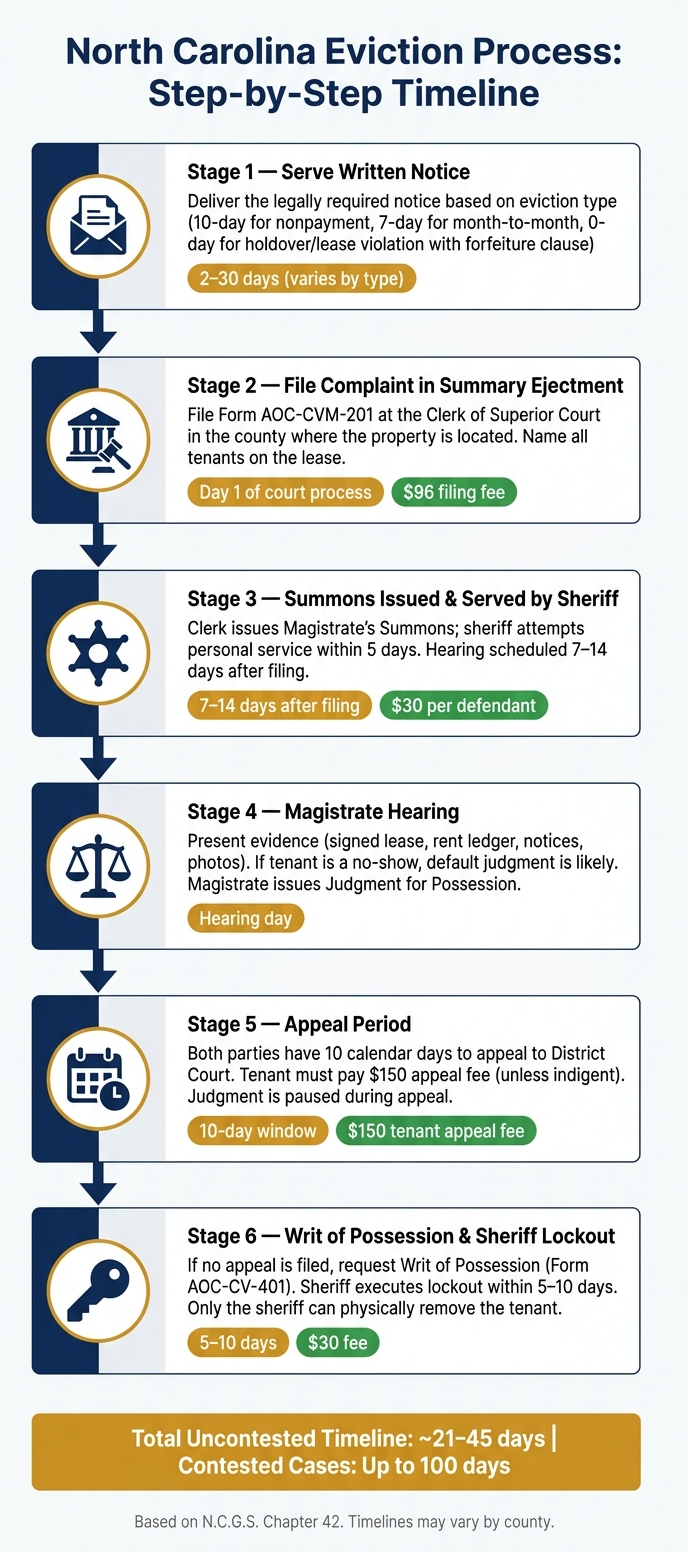
North Carolina Eviction Process: Step-by-Step Timeline
Once the proper notice period ends, the summary ejectment process begins, formalizing the eviction through the court system. Here’s how it works:
Filing the Complaint
To start, head to the Clerk of Superior Court in the county where your rental property is located , such as when managing rental property in Durham, and file a "Complaint in Summary Ejectment" (Form AOC-CVM-201). This filing costs $96. Make sure to name all tenants listed on the lease to avoid complications when enforcing the judgment. After filing, the clerk usually schedules a small claims hearing within 7 to 10 days. This step initiates the official eviction process and sets up the subsequent summons and hearing.
Issuance and Service of Summons
Once the complaint is filed, the clerk issues a Magistrate’s Summons to inform the tenant of the hearing details – date, time, and location. The summons is served by the sheriff for $30 per defendant. The sheriff attempts personal service within five days, but if that fails, they may leave the documents with a responsible adult or post them conspicuously at the property. Keep in mind, if service is only completed by posting, the magistrate can grant possession of the property but cannot issue a money judgment for unpaid rent.
Magistrate Hearing and Judgment
At the hearing, bring all necessary documentation, including the signed lease, rent ledger, notices, and any photos of property damage. Magistrates handle these cases quickly:
"The judge usually has 5 minutes per case – your stack of documents has to do the work fast." – Commoner Law
As the landlord, you must present evidence to support your case. If the tenant doesn’t show up, you’ll likely win a default judgment. If they do appear, the magistrate will review the evidence and decide whether to issue a Judgment for Possession. Before the hearing, confirm that the sheriff’s Return of Service has been filed, as the case cannot proceed without it. After the judgment, either party has the option to appeal.
Appeal Period
Even with a favorable judgment, the tenant cannot be removed immediately. Both parties have 10 calendar days to appeal the magistrate’s decision to District Court for a new trial. If the tenant decides to appeal, they must pay a $150 filing fee unless they qualify as indigent. During this time, the judgment is effectively paused.
Writ of Possession and Sheriff Removal
If no appeal is filed within the 10-day window, you can request a Writ of Possession (Form AOC-CV-401) from the court to proceed with the eviction. The sheriff then has 5 to 10 days to carry out the lockout. This step comes with an additional $30 fee. The eviction process is complete once the sheriff removes the tenant and secures the property.
It’s important to note that self-help eviction is illegal in North Carolina. Actions like changing locks, cutting off utilities, or removing a tenant’s belongings without a court order can lead to serious legal consequences.
| Stage | Typical Timeframe |
|---|---|
| Notice Period | 2–30 days (varies by type) |
| Filing to Hearing | 7–14 days |
| Appeal Period | 10 days |
| Writ Execution by Sheriff | 5–10 days |
| Total (Uncontested) | ~21–45 days |
Tenant Defenses and Evidence Preparation
Tenants often present defenses that can delay or even derail the eviction process. These defenses rely heavily on how well landlords follow the legal procedures discussed earlier. Understanding these potential defenses – and preparing to address them – can be a game-changer during a magistrate hearing.
Common Tenant Defenses
One of the most common defenses is improper notice or service. If notice or service isn’t executed correctly, it can lead to dismissal of the case. Filing prematurely can also result in dismissal.
Tenants may claim retaliatory eviction under N.C.G.S. § 42‑37.1, arguing that the eviction is a response to a valid complaint about habitability or code violations made within the last 12 months. Another frequent defense is breach of habitability, where the tenant asserts that the property was unlivable, violating the implied warranty of habitability outlined in N.C.G.S. § 42‑42.
"The implied warranty of habitability under N.C. Gen. Stat. § 42-42 is the most common reason North Carolina magistrates continue or dismiss summary ejectments." – EvictionRiskMap
A less obvious but equally important defense is waiver of breach. Accepting any payment after issuing notice can unintentionally create a new tenancy, jeopardizing the landlord’s right to evict. Legal expert Jessica Gillespie explains:
"The landlord must not accept any payment after the expiration of the lease term and before filing a complaint. This includes partial payment. Doing so may create a new tenancy." – Jessica Gillespie, MSLIS, Nolo
Evidence Landlords Should Prepare
To effectively counter tenant defenses, landlords need a well-organized evidence package. Magistrates work quickly, so presenting clear, printed evidence is essential – magistrates won’t review evidence directly from phones. Follow the "three-copy rule": prepare one copy for the magistrate, one for the tenant, and one for your own records.
Here’s a breakdown of key evidence types and the documents you should bring:
| Evidence Category | Documents & Their Purpose |
|---|---|
| Contractual Basis | Signed lease and written amendments – establishes tenancy terms and forfeiture clauses |
| Financial Records | Rent ledger, receipts, and late fee records – disputes claims of payment discrepancies |
| Notice Compliance | Copies of notices with proof of delivery – shows compliance with statutory notice periods |
| Communication | Printed emails, texts, and call logs – demonstrates tenant was informed of violations |
| Property Condition | Time-stamped photos and videos – refutes habitability claims or confirms property damage |
| Repair Documentation | Work orders, maintenance logs, and contractor invoices – rebuts claims of ignored repairs |
One crucial point: ensure the amount listed on your rent ledger matches the amount on your eviction notice exactly.
"If you’re off by a single dollar, or if you included a late fee that your lease doesn’t authorize under NCGS § 42-46, the notice is defective. The case gets thrown out." – Hemlane
Under NCGS § 42‑46, late fees are limited to $15 or 5% of the monthly rent, whichever is greater. Any fee exceeding this limit – or not explicitly stated in the lease – can invalidate the notice entirely.
Post-Eviction Steps for Landlords
Once the court process wraps up and the sheriff enforces the Writ of Possession, landlords still have important steps to follow. From securing the property to handling tenant belongings, here’s what you need to do before re-renting the unit.
Changing Locks and Securing the Property
The sheriff is the only person authorized to physically remove a tenant during an eviction. Attorney Rich Gittings of North Carolina Legal Services explains:
"The only person who can physically remove you from your home is a sheriff executing a Writ of Possession after a court process." – Rich Gittings, Attorney, North Carolina Legal Services
Attempting a self-help eviction – like changing the locks before the sheriff arrives – can lead to legal trouble, including damages and attorney fees. To avoid this, schedule a licensed locksmith to change the locks immediately after the sheriff executes the writ. This ensures the property is secured as soon as the tenant is removed.
Handling Tenant Belongings Left Behind
If a tenant leaves behind personal items, North Carolina law outlines specific rules for how landlords must handle them. Here’s a quick breakdown based on the value of the belongings:
| Property Value | Storage Period | Landlord Actions |
|---|---|---|
| Under $500 | 5 days | Considered abandoned after 5 days and can be disposed. |
| Under $750 | 30 days (if donated) | Can be donated to a qualifying nonprofit. |
| General/Over $750 | 7 days | Can sell or dispose after 7 days with written notice to the tenant. |
During the storage period, you cannot discard, sell, or damage the tenant’s belongings. If the tenant requests access, they must be allowed to retrieve their items during regular business hours. Should you decide to sell the property, you must send the tenant written notice at least seven days before the sale. Any money left over after covering unpaid rent, storage fees, and sale costs must either be returned to the tenant or handed over to the county government.
Post-Eviction Property Inspections
Once the tenant is removed, conduct a detailed walkthrough of the property. Take time-stamped photos and videos of every room to document the condition, which can help support any claims against the security deposit.
Landlords have 30 days after the tenancy ends to either return the security deposit or provide an itemized list of deductions. If repair costs aren’t finalized within that timeframe, you can issue an interim statement and follow up with a final accounting within 60 days. Address any major maintenance issues, like leaks, broken windows, or HVAC problems, before listing the unit again. Professional rental property management in Chapel Hill, NC can help streamline this transition and ensure legal compliance. As EvictionRiskMap explains:
"The cost of fixing a leaky faucet in week 1 is $80. The cost of losing a summary ejectment to a habitability defense is $3,000 in lost rent plus the case dismissal." – EvictionRiskMap
Neglecting repairs not only risks legal issues but could also hurt your chances in future eviction cases if a new tenant raises concerns about unresolved problems.
How Unicorn Rentals Can Help with Eviction Management

Unicorn Rentals offers landlords in Raleigh, Durham, Chapel Hill, and the Triangle region of North Carolina a streamlined approach to eviction management. From missed rent payments to sheriff lockouts, they handle every step with precision, ensuring the process is efficient, legally compliant, and as stress-free as possible.
Rent Collection and Lease Enforcement
Unicorn Rentals takes the hassle out of rent collection by ensuring payments are made consistently and on time. If a tenant falls behind, they issue the legally required 10-day Notice to Pay or Quit as outlined in N.C. Gen. Stat. § 42-3. This notice is delivered properly and within the required timeframe. To protect landlords’ eviction rights, they also enforce strict policies on partial payments, requiring specific written agreements before accepting any amount less than the full rent due.
Eviction Coordination Services
When a tenant fails to resolve nonpayment or lease violations, Unicorn Rentals steps in to manage the legal process. They handle everything, from preparing and filing the Complaint in Summary Ejectment (Form AOC-CVM-201) to coordinating with the county sheriff to serve the summons. They also compile all necessary documentation – such as signed leases, rent ledgers, and proof of notices – for the magistrate hearing. After a judgment is issued, they ensure compliance with the mandatory 10-day appeal period before requesting the Writ of Possession, keeping the process legally sound every step of the way.
In addition to eviction services, Unicorn Rentals helps landlords avoid future issues with proactive tenant screening and maintenance management.
Full-Service Property Management Support
The best way to handle evictions is to prevent them altogether. Unicorn Rentals screens potential tenants thoroughly, evaluating credit history, eviction records, and employment before signing a lease. They also manage maintenance requests with efficiency, documenting repairs with photos and completing them within seven days – a practice that helps landlords counter habitability defenses during eviction cases.
For added peace of mind, Unicorn Rentals offers tiered property management plans. Their Value+ (Tier 2) plan, priced at 13% of monthly rent, includes an Eviction Guarantee and Loss of Rent coverage for properties renting at $1,500 or more per month. For 15% of monthly rent, the Premium (Tier 3) plan adds features like preventive maintenance inspections and free lease renewals, further reducing the risk of disputes and legal complications.
Conclusion and Key Takeaways
Navigating the eviction process in North Carolina demands strict compliance with court procedures. Even minor errors – like missing notice deadlines or accepting unauthorized partial payments – can lead to costly restarts. The timeline for evictions varies: uncontested cases typically take 21–45 days, while contested ones can stretch up to 100 days. Costs include filing fees ranging from $96 to $126, an additional $30 per defendant for sheriff services, and potential losses from unpaid rent. Landlords should also avoid self-help actions like changing locks or cutting utilities without a court order, as these can lead to statutory damages between $1,500 and $5,000, plus attorney fees.
To minimize risks and delays, landlords should adopt key practices: follow all legal requirements precisely, maintain detailed records, and act promptly when tenants fall behind on rent. Address maintenance concerns in writing and document every step of the process to strengthen your position if disputes arise.
For landlords in the Triangle area who prefer professional assistance, Unicorn Rentals offers a range of services. From lease enforcement and notice preparation to full eviction coordination, their tiered property management plans also include perks like Eviction Guarantees and Loss of Rent coverage for eligible properties.
FAQs
What mistakes most often get an eviction case dismissed in North Carolina?
Eviction cases in North Carolina frequently get dismissed because of procedural errors. These errors can include issues like miscalculating the 10-day notice period, including late fees that aren’t allowed, or serving the summons incorrectly. Filing in the wrong county or attempting illegal self-help actions – like shutting off utilities – can also invalidate a case. Additionally, accepting partial rent after the notice period has ended or failing to provide enough evidence, such as proof of criminal activity, often results in dismissal.
Can a landlord accept any payment and still proceed with eviction?
Landlords should steer clear of accepting any payments after a lease term ends and before filing an eviction complaint. Even a partial payment during this period can unintentionally establish a new tenancy under the original lease terms. This could reset the eviction process or even lead to the case being dismissed entirely. For landlords in the Triangle area seeking assistance, Unicorn Rentals provides property management services to help ensure compliance with regulations.
What should I do if a tenant appeals after the magistrate’s decision?
If a tenant decides to challenge the magistrate’s decision, the case advances to District Court for a completely new trial. They have 10 calendar days to file their appeal. To remain in the property during this process, the tenant must submit a Bond to Stay Execution and pay their rent to the Clerk of Court. However, if they fail to meet the deadline or miss a payment, you can request a Writ of Possession to regain control of the property.