

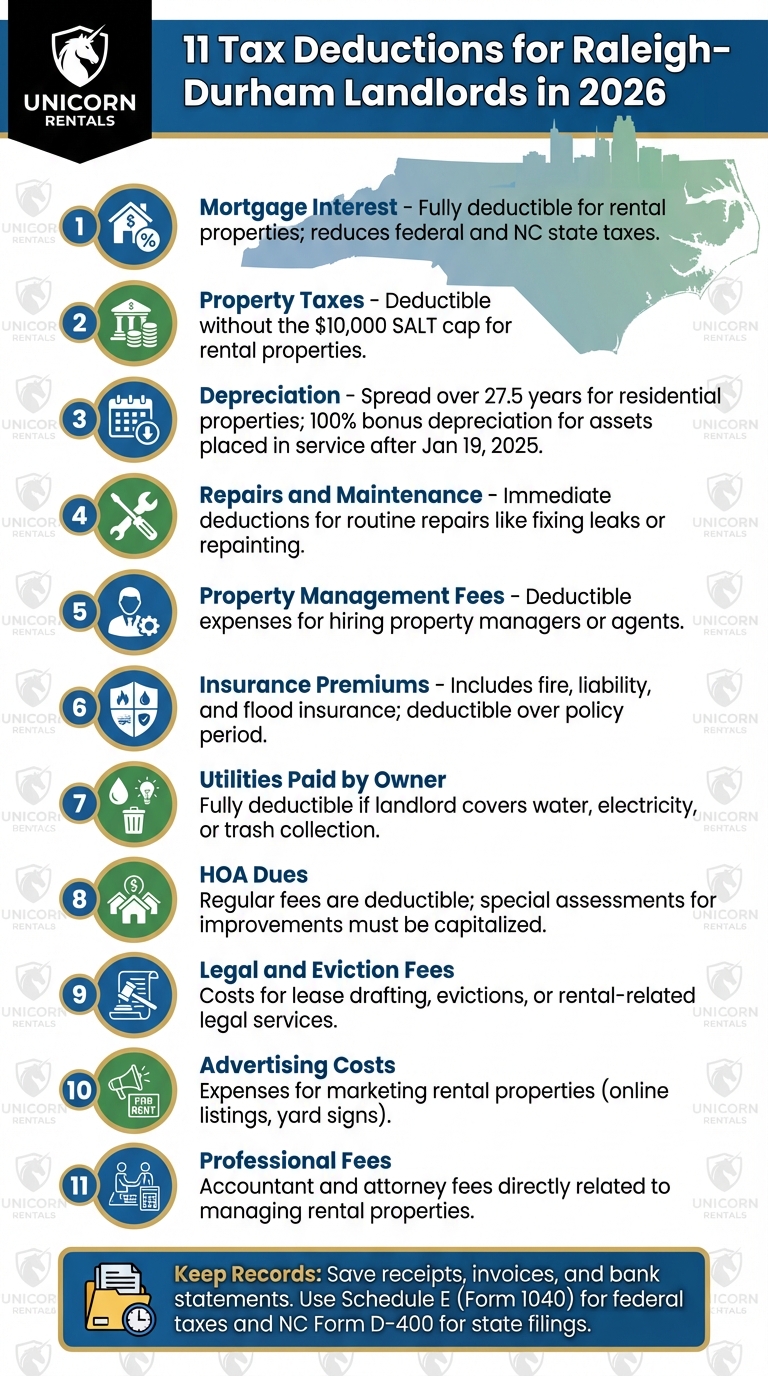
Landlords in Raleigh-Durham can significantly reduce their tax bills by leveraging key deductions available in 2026. From mortgage interest to property management fees, understanding these tax-saving opportunities is essential for maximizing profitability. Here’s a quick summary of the top deductions:
- Mortgage Interest: Fully deductible for rental properties; reduces both federal and North Carolina state taxes.
- Property Taxes: Deductible without the $10,000 SALT cap for rental properties.
- Depreciation: Spread over 27.5 years for residential properties; bonus depreciation of 100% applies to assets placed in service after January 19, 2025.
- Repairs and Maintenance: Immediate deductions for routine repairs like fixing leaks or repainting.
- Property Management Fees: Deductible expenses for hiring property managers or agents.
- Insurance Premiums: Includes fire, liability, and flood insurance; deductible over the policy period.
- Utilities Paid by Owner: Fully deductible if the landlord covers water, electricity, or trash collection.
- HOA Dues: Regular fees are deductible, but special assessments for improvements must be capitalized.
- Legal and Eviction Fees: Costs for lease drafting, evictions, or other rental-related legal services are deductible.
- Advertising Costs: Expenses for marketing rental properties, such as online listings or yard signs, are deductible.
- Professional Fees: Includes accountant and attorney fees directly related to managing rental properties.
Keep Records: Accurate documentation is critical – save receipts, invoices, and bank statements to support your deductions. Use Schedule E (Form 1040) for federal taxes and North Carolina’s Form D-400 for state filings.
11 Tax Deductions for Raleigh-Durham Landlords in 2026
1. Mortgage Interest
Eligibility for Deduction Under IRS Guidelines
If you’re a landlord using cash-basis accounting, the mortgage interest paid on loans solely for rental properties can be deducted as an ordinary and necessary expense. However, if you refinance and withdraw personal funds, only the interest tied to the rental portion of the loan remains deductible.
As for mortgage fees – such as recording fees, abstract fees, commissions, and points – these costs must be either capitalized or amortized over the life of the loan. This deduction not only lowers your tax bill but is also an important part of a smart tax strategy for landlords in the Raleigh-Durham area.
Relevance to Raleigh-Durham Landlords and North Carolina-Specific Tax Laws
For landlords in Raleigh-Durham, this deduction reduces both federal taxable income and North Carolina state tax liability. Since North Carolina state taxes are tied to your federal AGI, this creates a double benefit. Filing your rental income on Schedule E also helps you sidestep the $10,000 SALT cap that applies to homeowners. This is a significant advantage for landlords in this high-growth region.
Potential to Reduce Taxable Income
If your annual mortgage interest exceeds $600, you’ll receive a Form 1098, which documents the deductible amount. This deduction directly lowers your net rental income. For landlords in booming markets like Raleigh-Durham, it can even help you avoid or minimize the 3.8% Net Investment Income Tax.
Documentation and Compliance Requirements
To stay compliant, keep a record of Form 1098, canceled checks, and bank statements to prove your interest payments in case of an IRS audit. If the mortgage is shared among multiple owners, make sure to allocate the interest properly. Additionally, if you’ve used a portion of refinance proceeds for personal purposes, carefully allocate the interest accordingly. Proper documentation is key to maximizing your deductions and staying audit-ready.
2. Property Taxes
Eligibility for Deduction Under IRS Guidelines
If you own rental property, the IRS allows you to deduct property taxes as ordinary and necessary business expenses. These taxes are reported on Schedule E and are fully deductible without any caps or limits, unlike taxes on personal residences. However, there’s a catch: taxes that fund new improvements – like sidewalks, sewer systems, or street construction – must be capitalized instead of being deducted right away. On the other hand, taxes for maintaining or repairing existing local benefits can be deducted in full.
Relevance to Raleigh-Durham Landlords and North Carolina-Specific Tax Laws
For landlords in Raleigh-Durham, these guidelines directly tie into local tax practices. As of 2026, Raleigh’s property tax rate stands at 35.50 cents per $100 valuation. While Wake County’s relatively low rates might seem appealing, rising property values can lead to hefty tax bills. Additionally, Durham County’s independently set rates require landlords to stay vigilant about tracking their obligations.
These tax variations don’t just impact landlords – they also influence renters and small businesses in the area. With North Carolina’s flat income tax rate set to drop to 3.99% in 2026, every dollar you deduct in property taxes can help reduce both your federal and state tax burdens.
Potential to Reduce Taxable Income
One major advantage for rental property owners is that the SALT cap – which limits personal itemized deductions to $40,000 – doesn’t apply to rental properties. This means you can fully deduct your rental property taxes on Schedule E. Additionally, if your modified adjusted gross income (MAGI) is $100,000 or less, you’re eligible to deduct up to $25,000 in rental losses against other income. These combined benefits can significantly lower your taxable income.
Documentation and Compliance Requirements
To ensure you’re meeting IRS requirements, it’s crucial to keep thorough records. Save your official tax bills, canceled checks, and bank statements as proof of your deductions. Setting up a dedicated bank account for rental activities can also help you clearly separate business property tax payments from personal expenses. When reviewing your tax bill, make sure to identify any charges for local benefit improvements – these must be capitalized, while the base tax remains deductible.
Finally, if you own property in Raleigh-Durham but live in another state, don’t forget to file a North Carolina state income tax return. This is necessary to report your rental income and claim the deductions you’re entitled to.
3. Depreciation
Eligibility for Deduction Under IRS Guidelines
Depreciation allows you to recover the cost of your rental property over time without requiring an upfront expense. To qualify for this deduction, you need to meet a few key conditions: you must own the property, use it to generate rental income, and the property must have a useful life of more than one year. However, it’s important to note that land itself cannot be depreciated since it doesn’t wear out or lose value. When purchasing a property, you’ll need to separate the value of the building from the land to calculate the correct depreciable basis. Depreciation begins as soon as your property is ready and available for rent – even if no tenant has moved in yet.
For most residential rental properties placed in service after 1986, the IRS requires using the Modified Accelerated Cost Recovery System (MACRS). This method spreads the deduction over 27.5 years for residential properties, using the General Depreciation System.
"You can begin to depreciate rental property when it is ready and available for rent."
– IRS Publication 527
Understanding these rules is crucial for incorporating depreciation into your tax strategy, especially in markets like Raleigh-Durham.
Relevance to Raleigh-Durham Landlords and North Carolina-Specific Tax Laws
In Raleigh-Durham, federal depreciation rules play a significant role in shaping state tax outcomes. North Carolina adheres to federal depreciation guidelines, so your federal depreciation deductions generally flow through to your state return. If you’re an out-of-state landlord with properties in Raleigh-Durham, you’ll still need to file a North Carolina state tax return. Depreciation can help reduce your taxable income sourced from North Carolina.
In a rapidly growing market like the Triangle, where property values are climbing, accurately separating building costs from land costs is essential. Overestimating your depreciable basis could raise red flags with the IRS, so it’s wise to keep detailed records, including settlement statements and property appraisals, on hand for reference.
Potential to Reduce Taxable Income
Depreciation provides a powerful way to lower your taxable income because it’s a non-cash deduction that directly offsets rental income. For example, if your building is valued at $300,000, you could claim approximately $10,909 in annual depreciation ($300,000 ÷ 27.5 years). For eligible landlords, rental losses – including depreciation – can offset other income by up to $25,000, further reducing your tax burden.
Additionally, the 100% special bonus depreciation has been reinstated for qualified property acquired and placed into service after January 19, 2025. Beginning in the 2025 tax year, the Section 179 expense deduction limit will be $2,500,000. While this provision typically applies to business equipment rather than buildings, it’s worth noting for landlords with mixed-use properties or other qualifying assets.
Documentation and Compliance Requirements
Proper documentation is critical when claiming depreciation. Start by keeping your settlement statement (HUD-1), which details the purchase price and closing costs like abstract fees, recording fees, and owner’s title insurance. These costs factor into your property’s cost basis. If you make improvements – such as installing a new roof or upgrading an HVAC system – track these separately, as they must be depreciated over time rather than expensed immediately.
To claim depreciation, file IRS Form 4562 in the first year your property is placed in service. Be sure to document the exact date your property became "ready and available" for rent, as the IRS uses a mid-month convention, assuming the property was placed in service at the midpoint of the month. Finally, distinguish between repairs and improvements: repairs like fixing a leaky faucet can be deducted immediately, while larger projects, such as a kitchen renovation, must be depreciated over several years.
4. Repairs and Maintenance
Eligibility for Deduction Under IRS Guidelines
Repairs and maintenance costs are fully deductible in the year they’re paid, offering immediate tax benefits. According to the IRS, repairs are defined as expenses that maintain your property’s current condition without increasing its lifespan [4,15]. Examples include fixing leaks, repainting walls, or performing routine HVAC servicing [3,5]. Additionally, you can deduct the cost of materials and supplies used specifically for these repair tasks [3,4].
It’s important to understand the difference between repairs and improvements. For instance, fixing a leaky faucet qualifies as a repair and can be deducted right away. On the other hand, replacing an entire plumbing system is considered an improvement and must be depreciated over several years. IRS safe harbor rules can help simplify the process of categorizing these expenses. Keeping accurate records and clearly distinguishing between repairs and improvements is essential for proper tax reporting.
Relevance to Raleigh-Durham Landlords and North Carolina-Specific Tax Laws
In North Carolina, the state tax rules align closely with federal guidelines, meaning Schedule E expenses also reduce your state taxable income. This is particularly useful for landlords in the Triangle area, covering Raleigh, Durham, and Chapel Hill. Local transportation costs for property maintenance are fully deductible, and for the 2025 tax year (filed in 2026), the standard mileage rate is 70 cents per mile.
North Carolina’s flat income tax system requires all rental income from properties within the state to be reported, even if the owner resides elsewhere. Fortunately, ordinary maintenance costs like landscaping, pest control, and routine upkeep are deductible on both federal and state returns. If you actively manage your properties and your modified adjusted gross income is $100,000 or less, you may also qualify to deduct up to $25,000 in rental losses, which includes repair expenses.
Documentation and Compliance Requirements
Proper documentation is critical for claiming repair deductions. Keep detailed records, including receipts, canceled checks, and invoices, organized by property and date. If you own multiple rental units in the Raleigh-Durham area, consider filing a separate Schedule E for each property (up to three) to maintain clear financial reporting. For travel-related expenses, maintain a mileage log that includes the date, destination, and purpose of each trip [3,5].
"You must be able to document this information if your return is selected for audit. If you are audited and cannot provide evidence to support items reported on your tax returns, you may be subject to additional taxes and penalties." – IRS
To avoid errors, categorize expenses as either repairs or improvements as soon as they occur. If tenants reimburse you for repair costs, make sure to include those amounts as rental income. For properties used both as rentals and for personal purposes, split maintenance expenses based on the number of days the property was used for each purpose.
5. Property Management Fees
Eligibility for Deduction Under IRS Guidelines
Property management fees are classified as fully deductible expenses under IRS guidelines, as long as they meet the criteria of being "ordinary and necessary". This means you can claim deductions for payments made to property management companies, commissions paid to rental agents for securing tenants, and fees from independent contractors like bookkeepers or accountants who handle your rental property finances. If you’re dealing with a mixed-use property, these fees need to be prorated. These deductions are a key tool for landlords in Raleigh-Durham to effectively lower their taxable rental income.
Relevance to Raleigh-Durham Landlords and North Carolina-Specific Tax Laws
In North Carolina, the state aligns with federal regulations for rental deductions, which are reported on Schedule E. This means that any management fees deductible on your federal tax return are also deductible on your state return. Thanks to North Carolina’s flat income tax system, calculating your tax savings is straightforward. Additionally, landlords in the state with a Modified Adjusted Gross Income (MAGI) of $100,000 or less can deduct up to $25,000 in rental losses, which can include property management fees.
Documentation and Compliance Requirements
Just like with other rental expenses – such as mortgage interest or repairs – accurate documentation is critical for claiming deductions on property management fees. Ensure you maintain records like receipts, canceled checks, monthly statements from property managers, and copies of management agreements. Using a dedicated bank account for all rental property transactions can also simplify record-keeping.
"You can deduct the ordinary and necessary expenses for managing, conserving and maintaining your rental property." – IRS
Make sure to record fees and commissions as they are incurred to capture every deduction. If your tenants cover a management-related expense and deduct it from their rent, you must include that amount in your rental income and then claim it as an operating expense. This ensures compliance while maximizing your deductions.
6. Insurance Premiums
Eligibility for Deduction Under IRS Guidelines
Insurance premiums are considered fully deductible as ordinary and necessary expenses under IRS rules. This includes premiums for fire, theft, flood, and landlord liability insurance.
"Necessary expenses are those that are deemed appropriate, such as interest, taxes, advertising, maintenance, utilities and insurance." – IRS
For multi-year policies, the deduction must be spread out over the policy’s coverage period. For instance, if you pay $3,000 in 2026 for a three-year liability policy, you can only deduct $1,000 on your 2026 tax return. The remaining $2,000 would be allocated to the next two years. Additionally, if you provide health insurance for employees managing your rental property, those costs are also fully deductible.
Relevance to Raleigh-Durham Landlords and North Carolina-Specific Tax Laws
Landlords in Raleigh-Durham should pay close attention to flood and storm insurance, as these premiums are deductible under the same guidelines as fire or liability coverage. With North Carolina’s vulnerability to severe weather, such policies can represent a significant deductible expense. It’s also worth noting that North Carolina’s flat income tax system applies to rental income from properties within the state, regardless of where the landlord resides.
Potential to Reduce Taxable Income
Insurance premiums directly reduce gross rental income, lowering both federal and state tax liabilities. For landlords with a modified adjusted gross income (MAGI) of $100,000 or less, up to $25,000 in rental losses – including insurance expenses – can be deducted against other income. Unlike the $40,400 SALT deduction cap set for personal homeowners in 2026, insurance costs for rental properties remain fully deductible as business expenses with no cap. Keeping accurate records is key to taking full advantage of these deductions.
Documentation and Compliance Requirements
Make sure to maintain detailed records of all insurance-related payments, such as policy declarations, bills, and canceled checks. Using a dedicated rental account can make tracking these expenses easier. If you’re renting out part of your primary residence – like a room or basement apartment in Raleigh – you’ll need to calculate and deduct only the portion of the homeowners insurance that applies to the rented space. All insurance expenses should be reported on Schedule E (Form 1040), Line 9.
7. Utilities Paid by Owner
Eligibility for Deduction Under IRS Guidelines
If you’re a landlord covering utilities like water, electricity, natural gas, sewage, or trash collection, the IRS allows you to fully deduct these expenses. However, if your tenants pay utilities and deduct them, you’ll need to include those amounts in your gross rental income and then deduct them as an expense. For properties used partially for personal purposes – such as living in one unit of a multi-unit property – you’ll need to allocate utility costs between personal and rental use. This can be done based on square footage or the number of days the property is used for each purpose.
"You generally must have documentary evidence, such as receipts, canceled checks or bills, to support your expenses." – IRS
Relevance to Raleigh-Durham Landlords and North Carolina-Specific Tax Laws
In Raleigh-Durham and across North Carolina, landlords benefit from following federal guidelines for rental deductions. These expenses are reported on Schedule E to determine taxable income under the state’s flat tax system. Every utility expense you deduct directly reduces the income subject to this flat rate, making it a practical way to manage your tax liability. Utility costs can vary significantly by county, which may influence your annual expenses. It’s important to note that costs for initial installations, like water or sewer systems, cannot be deducted as expenses. Instead, they must be added to your property’s basis. On the other hand, ongoing maintenance or repairs for these systems are fully deductible.
Potential to Reduce Taxable Income
Deducting utility costs is a straightforward way to lower your taxable income. These deductions reduce your gross rental income, which in turn lowers both federal and state tax liabilities. If your rental properties generate a loss, you may be able to offset other income. For instance, if your modified adjusted gross income is $100,000 or less, you could deduct up to $25,000 in rental losses against other income. Unlike the capped SALT deduction for personal homeowners, utility expenses for rental properties remain fully deductible as business expenses.
Documentation and Compliance Requirements
To ensure compliance, keep detailed records, including utility bills, receipts, and canceled checks. Using a dedicated bank account for your rental property makes it easier to track these expenses. Be sure to report all utility costs on Schedule E (Form 1040) to stay aligned with IRS requirements.
sbb-itb-aa27f6d
8. HOA Dues
Eligibility for Deduction Under IRS Guidelines
If your property is part of a homeowners association (HOA), the dues you pay may qualify as a business expense deduction. According to the IRS, these fees are considered an ordinary and necessary cost of maintaining a rental property. Regular HOA dues – covering services like landscaping, maintenance, security, and general upkeep – are fully deductible in the year they are paid.
"If your property is used for rental purposes, the IRS considers HOA fees tax deductible as a rental expense." – H&R Block
However, there’s a distinction when it comes to special assessments. If the fees are for major improvements – like adding a new pool, repaving roads, or replacing roofs – they must be capitalized and depreciated over time. On the other hand, assessments for repairs or maintenance can be deducted immediately in the year they are paid. If your Raleigh-Durham rental property is used for personal purposes for more than 14 days or 10% of the total rental days, you’ll need to prorate the HOA deduction based on the time the property is rented. This aligns with other rental expense strategies, making it a valuable deduction for landlords in the Raleigh-Durham area.
Relevance to Raleigh-Durham Landlords and North Carolina-Specific Tax Laws
For landlords in Raleigh-Durham, deducting HOA dues on Schedule E not only reduces federal taxable income but also lowers North Carolina taxable income. This deduction avoids the limitations of the SALT cap, offering a tax advantage.
Potential to Reduce Taxable Income
By deducting HOA dues, your gross rental income decreases, which in turn lowers your overall tax liability.
Documentation and Compliance Requirements
To stay compliant, keep all HOA billing statements and proof of payment. Distinguish between regular dues, which are immediately deductible, and special assessments, which must be capitalized if they cover improvements. When filing taxes, report your HOA dues on Schedule E (Form 1040) under "Management fees" or "Other" expenses. Using a dedicated rental account can make it easier to track these expenses and maintain clear records.
Top Tax Deductions You Need to Know as a First-Time Landlord (2026)
9. Legal and Eviction Fees
Legal and eviction fees, like other rental expenses, can lower your taxable income when properly documented.
Eligibility for Deduction Under IRS Guidelines
Legal and professional fees tied to rental management are considered deductible operating expenses. According to the IRS, landlords can deduct attorney fees for tasks such as drafting lease agreements, collecting overdue rent, and handling evictions. These expenses must directly contribute to managing, conserving, or maintaining the rental property.
"Operating expenses – Other expenses necessary for the operation of the rental property, such as the salaries of employees or fees charged by independent contractors (groundkeepers, bookkeepers, accountants, attorneys, etc.) for services provided." – IRS
If you use the cash method of accounting (common for individual landlords), you can only deduct legal expenses in the year they are paid, not when billed. If a tenant reimburses you for legal expenses (e.g., through a settlement), you must report those reimbursements as rental income. However, the original legal expenses remain deductible. These general rules also align with specific legal procedures in the Raleigh-Durham area, as described below.
Relevance to Raleigh-Durham Landlords and North Carolina-Specific Tax Laws
In North Carolina, the legal eviction process is referred to as Summary Ejectment, governed by N.C. General Statutes Chapter 42. Filing fees for Summary Ejectment typically cost around $96, with additional sheriff fees ranging from $30 to $50. Landlords in Wake County can streamline this process using the eCourts online portal, which simplifies filing and improves record-keeping. State law also allows landlords to include eviction-related fees in lease agreements.
With North Carolina’s flat income tax rate set to drop to 3.99% in 2026, deducting legal and eviction fees can help landlords in the Raleigh-Durham market maintain profitability. These deductions should be reported on Schedule E (Form 1040).
Documentation and Compliance Requirements
To ensure compliance, maintain clear records of legal expenses, including invoices, court filing receipts, and payment confirmations (e.g., canceled checks or electronic receipts). If you own multiple rental properties in the Triangle area, keep income and expenses for each property separate on Schedule E. Using a dedicated bank account exclusively for rental transactions can also help avoid mixing personal and business finances.
It’s important to avoid "self-help" evictions, such as changing locks or shutting off utilities, as these practices are illegal in North Carolina and could lead to lawsuits for damages. Legal fees from defending against wrongful eviction lawsuits may not qualify for the same tax treatment as standard operating legal fees. Additionally, if you deduct eviction fees from a tenant’s security deposit, North Carolina law requires you to provide the tenant with an itemized list of those deductions within 30 days. You must also report the deducted amount as rental income while still deducting the actual expense. Following these guidelines can simplify your tax documentation process for 2026 and beyond.
10. Advertising and Marketing Costs
Did you know that the money you spend marketing your rental property to attract tenants can help lower your taxable income? Many property owners miss out on this opportunity, but advertising expenses – like online listings, print ads, yard signs, or even commissions paid to rental agents – are fully deductible when properly documented.
Eligibility for Deduction Under IRS Guidelines
According to the IRS, advertising qualifies as a necessary and ordinary expense for managing a rental property. This means you can deduct costs associated with promoting your property, including fees for online platforms, newspaper ads, physical signage, and agent commissions. If you operate on a cash basis, you can claim these deductions in the year you pay for them. However, if your property serves both personal and rental purposes, you’ll need to allocate expenses proportionally. These rules align with other rental-related deductions, making them a valuable tool for property owners.
Relevance to Raleigh-Durham Landlords and North Carolina-Specific Tax Rules
For landlords in Raleigh-Durham and across North Carolina, advertising costs benefit from both federal and state tax guidelines. North Carolina mirrors federal rules for rental business expenses, meaning advertising costs that qualify on your federal Schedule E will typically carry over to your state tax return. Unlike personal itemized deductions, which may be subject to the $40,400 SALT cap in 2026, business-related expenses like advertising aren’t affected by this limit. This is especially beneficial for landlords in the Triangle area, where rental income is taxed at a flat rate regardless of residency. Plus, if your modified adjusted gross income is $100,000 or less, you may qualify to deduct up to $25,000 in rental losses.
Documentation and Compliance Requirements
To make the most of these deductions, thorough documentation is key. Save receipts, invoices, and canceled checks for all marketing-related expenses. If you travel to meet with vendors or post physical advertisements, track your mileage – remember, the standard rate for 2025 is 70 cents per mile. Using a dedicated rental account can simplify tracking and ensure accuracy when reporting these costs on Schedule E (Form 1040). These deductions also apply to your North Carolina state tax return, giving you an added incentive to stay organized.
11. Professional Fees
Landlords often rely on professionals like accountants, attorneys, bookkeepers, and tax preparers to handle the complexities of managing rental properties. The IRS allows deductions for fees paid for services that are directly tied to rental management, classifying them as "ordinary and necessary" business expenses.
Eligibility for Deduction Under IRS Guidelines
To qualify for a deduction, professional fees must be directly connected to managing or maintaining your rental property. Examples include costs for preparing your Schedule E tax form, legal fees for drafting rental agreements, and accounting services for tracking rental income and expenses. However, fees related to mortgage transactions – such as commissions or abstract fees – are not immediately deductible. Instead, these are capitalized and added to your property’s basis. These deductions, when combined with other rental expense strategies, can significantly lower your overall tax burden.
Relevance to Raleigh-Durham Landlords and North Carolina-Specific Tax Laws
North Carolina aligns with federal tax guidelines for rental property deductions. This means that professional fees deducted on your federal Schedule E typically carry over to your state tax return. Since North Carolina calculates state taxes based on your Federal Adjusted Gross Income, these deductions can reduce both federal and state taxable income. For landlords in Raleigh-Durham, this dual benefit makes tracking and deducting professional fees especially worthwhile. Additionally, if your modified adjusted gross income is $100,000 or less, you may be eligible to deduct up to $25,000 in rental losses against other income.
Documentation and Compliance Requirements
Good record-keeping is essential for claiming professional fee deductions. Maintain receipts, invoices, and bank statements – ideally from a dedicated rental account – to document these expenses. If your accountant handles both your personal and rental taxes, request an itemized invoice that clearly separates the cost of preparing your Schedule E. Only the rental-related portion qualifies as a deductible expense. Additionally, if you travel to meet with professionals, log your mileage and apply the current standard mileage rate for further deductions. Proper documentation ensures compliance and maximizes your eligible deductions.
Documentation and Compliance Tips
Keeping accurate records – such as receipts, canceled checks, and bills – is essential for backing up every expense you claim. Without proper documentation, you could lose deductions during an audit or even face penalties.
When it comes to reporting, rental income and expenses should be filed on Schedule E (Form 1040). For depreciation, including the 100% bonus depreciation on property placed in service after January 19, 2025, you’ll need Form 4562. Your mortgage lender will provide Form 1098 to document interest paid. If your rental losses are limited by passive activity rules, you’ll also need to complete Form 8582. For travel expenses related to property management, be sure to keep a detailed log, noting mileage, dates, and the purpose of each trip. This allows you to claim the 70 cents per mile deduction.
If you’re filing taxes in North Carolina, there are additional steps to consider. You’ll use Form D-400, and potentially Schedule A if you’re itemizing deductions. However, state limits differ from federal rules. For example, North Carolina caps the combined deduction for mortgage interest and property taxes at $20,000, while real estate taxes alone are limited to $10,000. This is stricter than federal limits, where the SALT (State and Local Taxes) deduction will rise to $40,000 for 2025 and 2026.
| Deduction Type | Federal Limit (2025/2026) | North Carolina Limit (2025/2026) |
|---|---|---|
| SALT (Real Estate Taxes) | $40,000 (subject to MAGI) | $10,000 |
| Mortgage Interest + Property Tax | No combined cap (subject to SALT cap) | $20,000 total |
| Standard Mileage Rate | 70 cents per mile | Follows federal for business |
These record-keeping habits are the foundation for effective tax planning.
For the 2026 tax year, consulting a tax professional is a smart move. Bonus depreciation rules are particularly tricky – property placed in service between January 1 and January 19, 2025, follows phase-down rules, while property placed in service after January 19 qualifies for the full 100% allowance. A skilled accountant can help you navigate these timing differences, understand North Carolina’s deviations from federal rules, and take advantage of deductions like the $2,500,000 Section 179 expense limit. Plus, since tax preparation costs for Schedule E are deductible as a rental expense, professional advice not only reduces audit risks but also ensures you’re making the most of available deductions.
Conclusion
Using these 11 deductions can help reduce taxable income and improve overall profitability. Expenses like insurance, utilities, and repairs – considered both ordinary and necessary – can lower taxable income at both the federal and state levels. Additionally, depreciation offers a way to recover the cost of income-generating property over time without requiring a cash outlay.
It’s also crucial to stay updated with current tax regulations. Tax laws change quickly, and keeping up can mean significant savings. For instance, bonus depreciation now allows for immediate expensing of qualified properties. While federal rules permit up to $40,000 in SALT deductions, North Carolina’s cap remains lower.
To make the most of these deductions, it’s essential to incorporate them thoughtfully into your tax planning. Federal and state variations – like North Carolina’s $20,000 combined cap on mortgage interest and property taxes – highlight the importance of consulting with a tax professional. A CPA familiar with the Triangle area can help differentiate between repairs and improvements, time bonus depreciation effectively, and ensure all documentation is in order to prepare for potential audits.
FAQs
What tax deductions should Raleigh-Durham landlords know about in 2026?
As a landlord in Raleigh-Durham, there are several tax deductions available in 2026 that can help lower your taxable income and improve your bottom line. These deductions include:
- Mortgage interest: Deduct the interest paid on loans tied to your rental property.
- Property repairs: Expenses for fixes like plumbing issues, painting, or roof maintenance can be written off.
- Depreciation: Claim the gradual loss of value on your property over time.
- Property management fees: If you use a professional service, their fees are deductible.
- Other qualifying expenses: This includes costs like insurance premiums, advertising for tenants, and HOA fees.
To make the most of these deductions while staying compliant with tax laws, maintain thorough records and work with a tax professional who understands North Carolina’s tax regulations.
What is depreciation, and how can Raleigh-Durham landlords use it to save on taxes?
Depreciation offers a great way for Raleigh-Durham landlords to offset the costs of owning rental properties. It allows you to deduct a portion of your property’s value each year, effectively lowering your taxable income and easing your overall tax burden.
Here’s how it works: to qualify, you need to own the property, use it as a rental, and ensure it has a measurable useful life (for residential properties, this is typically 27.5 years). Keeping detailed records is key – track the purchase price, any improvements, and related expenses. These details help you accurately calculate and claim depreciation, making your rental property more profitable while staying within the bounds of tax regulations.
What records do I need to claim tax deductions for my rental property?
To take full advantage of tax deductions for your rental property, it’s crucial to maintain organized and precise records. Here’s what you’ll need:
- Income records: Keep track of every rental payment you receive.
- Expense receipts: Save receipts for costs like repairs, maintenance, utilities, and property management fees.
- Invoices: Retain bills from contractors or professional services.
- Depreciation schedules: Document how you’re accounting for the property’s depreciation over time.
Store these documents securely and in an orderly manner. They’re your key to justifying deductions, especially if the IRS decides to review your tax return.
Related Blog Posts
- Raleigh & Durham Rental Market 2026: Trends, Rent Forecasts, and What It Means for Landlords
- How Much Should You Charge for Rent in Raleigh, Durham & Chapel Hill in 2026 (By Bedroom & Neighborhood)
- 100% Bonus Depreciation – Full Guide For NC Hosts
- Extended Stay / Mid-Term Rentals vs Short-Term (Airbnb) vs Long-Term Rentals: Profitability in the Raleigh–Durham Triangle, NC