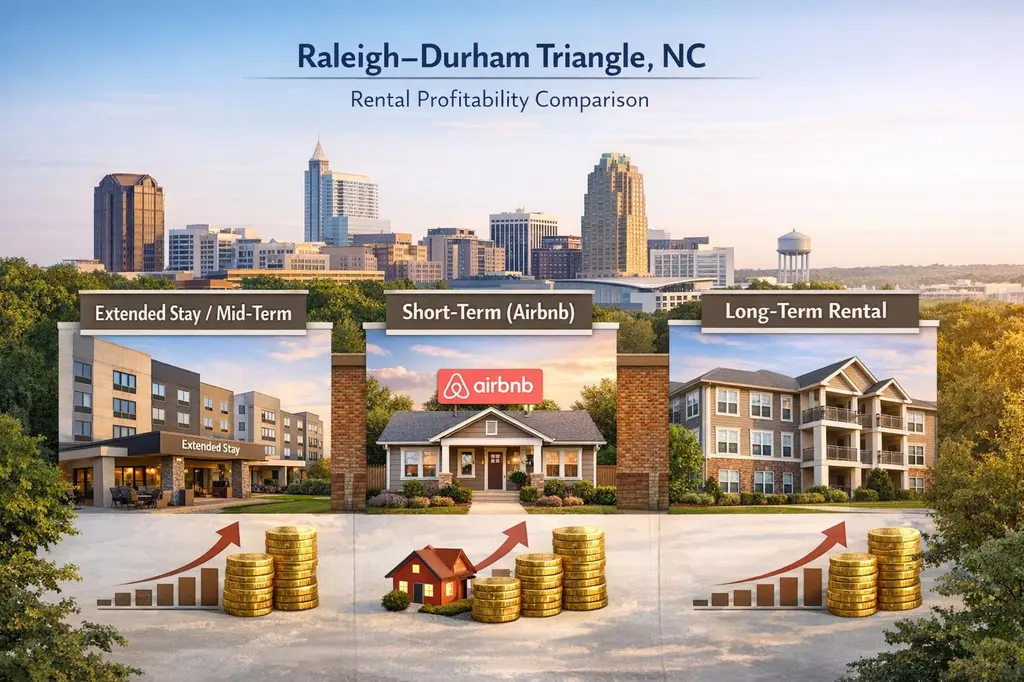
In the Raleigh–Durham Triangle, choosing the right rental strategy depends on balancing income potential, management effort, and regulations. Here’s a quick summary of the three main options:
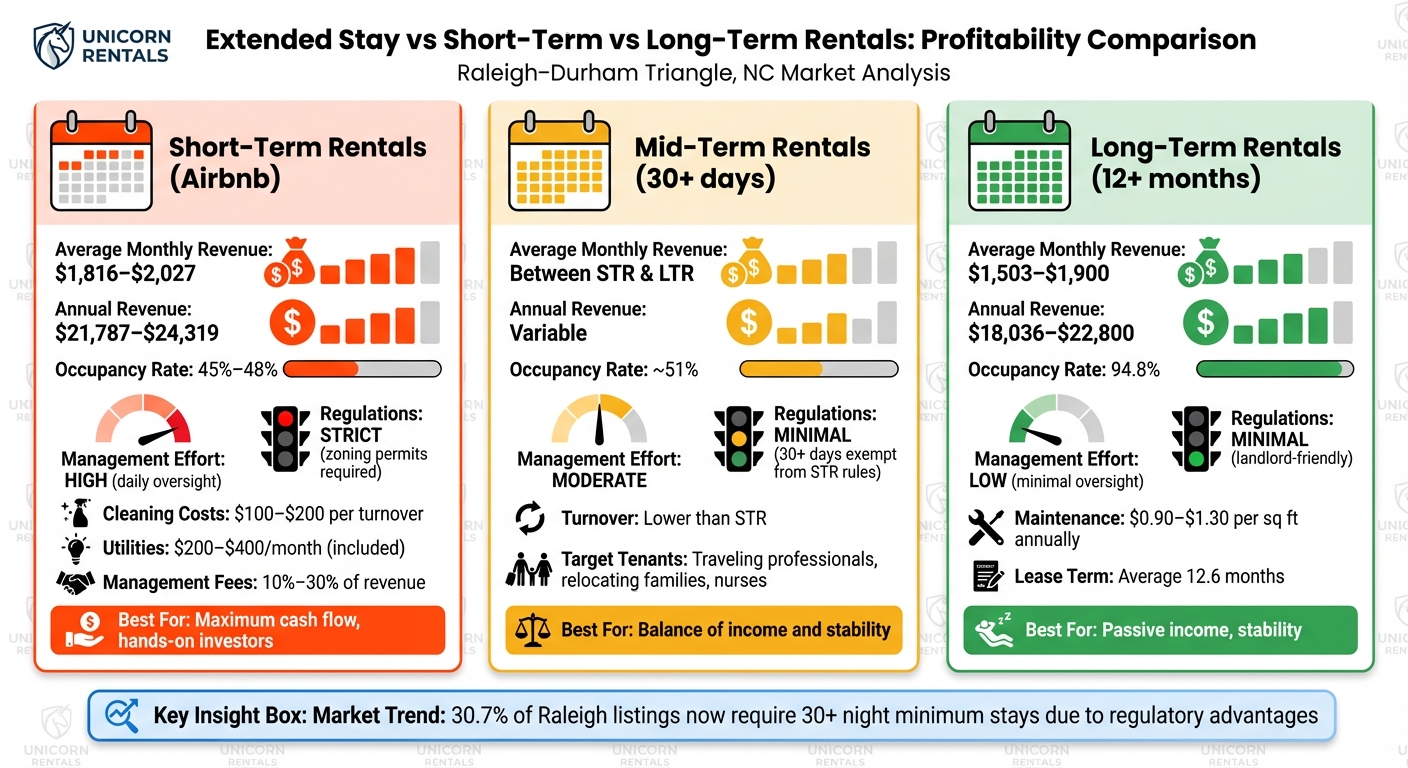
- Short-Term Rentals (Airbnb): Higher revenue potential with average annual earnings of $24,319 in Raleigh. However, occupancy rates hover around 45%, and these rentals require daily management, frequent cleanings ($100–$200 per turnover), and compliance with strict regulations in Raleigh.
- Mid-Term Rentals (30+ days): A balance between short-term and long-term models. These rentals cater to traveling professionals and relocating families, offering steadier income than short-term rentals and fewer turnovers. Regulatory requirements are less stringent, and occupancy rates average 51%.
- Long-Term Rentals (12+ months): The most stable option with a 94.8% occupancy rate. Monthly rents average $1,503–$1,900, and management demands are minimal, focusing on routine maintenance and tenant relations.
Quick Comparison
| Rental Model | Avg. Monthly Revenue | Occupancy Rate | Management Effort | Key Features |
|---|---|---|---|---|
| Short-Term (Airbnb) | $1,816–$2,027 | 45%–48% | High (daily oversight) | High revenue, seasonal income |
| Mid-Term (30+ days) | Between STR & LTR | ~51% | Moderate | Steady income, fewer turnovers |
| Long-Term (12+ mos) | $1,503–$1,900 | 94.8% | Low | Stable income, minimal effort |
Each model has pros and cons. Short-term rentals maximize cash flow but require constant attention. Mid-term options offer flexibility and reduced turnover costs. Long-term rentals provide consistent income with less work, making them ideal for passive investors. Your choice should align with your property’s location, features, and your ability to manage operations.
Raleigh-Durham Rental Strategy Comparison: STR vs MTR vs LTR Profitability
Short-Term Rentals (Airbnb & Similar Platforms)
Revenue and Market Performance
Short-term rentals in the Triangle area, including Raleigh and Durham, command impressive nightly rates, though occupancy rates tend to fluctuate. As of 2026, Raleigh properties bring in an average daily rate of $181, while Durham properties follow closely at $172. However, these nightly rates don’t tell the whole story – occupancy rates hover around 45.2% in Raleigh and 44.7% in Durham. When combining these figures, the median annual revenues come out to $24,319 for Raleigh and $21,787 for Durham.
Seasonal trends have a significant impact on earnings. October consistently stands out as the most lucrative month, with Raleigh properties earning $3,352 on average compared to just $2,044 in January. Durham properties follow a similar seasonal pattern, with October being the high point and winter months bringing in lower revenue.
Some properties, however, show what’s possible with the right strategy. Take the Neuse Haven property in Raleigh, for example – a 5-bedroom home that earned $191,703 in revenue from December 2024 to December 2025. This was achieved with a 43.6% occupancy rate and an average nightly rate of $1,169.16. In Durham, a 4-bedroom home equipped with a fire pit and hot tub brought in $147,561 in 2025, maintaining a 55.9% occupancy rate and a nightly rate of $700.78. These numbers highlight the revenue potential for well-managed properties, though they also come with significant operational demands.
Management Requirements
Operating a short-term rental is no small feat – it requires constant attention to detail. Every guest turnover involves professional cleaning and sanitizing, which typically costs professional cleaning, which typically costs $100–$200 per stay00–$200 per stay, along with fresh linens, restocking supplies, and thorough property inspections. Hosts must also handle guest communications promptly, coordinate check-ins and check-outs, and adjust pricing to match demand, especially during peak seasons.
For those who find this workload overwhelming, professional property management services are an option. These services generally charge between 10% and 30% of rental income to take over daily operations. However, even with professional help, there are additional costs to consider. Utility bills, which are usually included in the nightly rate rather than passed on to guests, can range from $200 to $400 per month. Whether self-managing or outsourcing, maintaining high ratings and consistent occupancy requires a significant time investment.
Local Regulations and Compliance
When it comes to regulations, Raleigh has stricter requirements for short-term rentals compared to Durham. In Raleigh, operators must secure an annual zoning permit and display the permit number on all advertisements and on-site. Rentals are only allowed as "Limited Use" in specific zoning districts, such as R-1, R-2, R-4, R-6, R-10, RX, OX, NX, CX, and DX.
For multi-unit buildings, the rules tighten further – a maximum of 25% of units or two units, whichever is greater, can operate as short-term rentals. Additional restrictions include a cap on occupancy at two people per bedroom plus two extra adults, and guest vehicles cannot exceed the number of bedrooms. Hosts are also required to maintain a guest registry for at least three years in case of city inspection.
Tax obligations add another layer of complexity. Hosts must pay a 4.75% state sales tax along with local occupancy taxes, which range from 2% to 6% in Wake County. Despite these regulations, compliance appears to be low – only about 13%–14% of active listings in Raleigh currently display proper licensing, suggesting that many operators may be operating outside the rules.
sbb-itb-aa27f6d
Mid-Term / Extended Stay Rentals
Who Rents Mid-Term and Why
Mid-term rentals, which typically cover stays lasting from 30 days to 12 months, appeal to a specific group of renters. The region’s thriving industries – spanning research, healthcare, IT, and education – create a steady demand for housing from traveling nurses, corporate professionals relocating for work, digital nomads, and students or academics on temporary assignments.
"The Triangle is visited year-round by travelling professionals in the research, medical, IT, and education space." – Benjamin Carver, local real estate agent
This type of housing is also popular with families and individuals looking for accommodations lasting one to three months. These renters often prefer furnished units that include utilities, high-speed internet, and designated workspaces. Location plays a significant role in demand, with hotspots near Research Triangle Park (RTP), Raleigh-Durham International Airport (RDU), and major healthcare providers such as WakeMed, UNC Health, and Duke Health [15, 16]. The diverse tenant base in this market offers a compelling mix of income potential and operational stability, which we’ll dive into next.
Income Consistency and Management Needs
Mid-term rentals strike a balance between the higher income of short-term stays and the steadiness of long-term leases. While nightly rates for mid-term rentals are about 27% lower than short-term options, they’re still 50%–100% higher than typical long-term lease rates [20, 23]. These rentals also tend to have an average occupancy rate of 51%, with stays generally falling between 30 and 120 days – much longer than the 3–4 night duration common for short-term bookings [20, 23].
One of the biggest advantages of mid-term rentals is the reduced turnover cost. Since tenants stay longer, landlords avoid the frequent cleaning and restocking expenses associated with short-term rentals.
"A single corporate tenant can provide stable, high-margin income for an entire quarter, reducing cleaning, administrative, and vacancy costs." – AvenueWest Global
In terms of management, mid-term rentals require less day-to-day attention than short-term properties but demand more oversight than traditional annual leases.
Regulatory Requirements
Mid-term rentals also offer a regulatory edge in Raleigh. Rentals lasting 30 days or more are classified as long-term, meaning they’re not subject to the restrictions and permit requirements that apply to short-term rentals [12, 13, 24].
Many landlords adopt a hybrid strategy by renting some rooms as short-term stays while reserving others for mid-term tenants, maximizing occupancy while staying within regulatory boundaries. Additionally, the North Carolina Vacation Rental Act (Chapter 42A) excludes rentals for business or employment purposes, covering most mid-term tenants like traveling nurses and corporate relocators. However, landlords should confirm zoning classifications using the Raleigh iMaps tool and steer clear of properties with restrictive HOAs that may prohibit shorter-term rentals [12, 24].
Long-Term Rentals
Consistent Income and Tenant Relations
Long-term rentals offer the advantage of steady monthly income, thanks to leases that typically last 12 months or more. This provides a level of financial predictability that short-term rentals, often impacted by seasonal fluctuations, can’t always match.
As of January 2026, rental prices across the Triangle area reflect this stability. Raleigh averages $1,695 per month, with one-bedroom units ranging from $1,198 to $1,436, and four-bedroom homes averaging $2,534. Durham is slightly higher at $1,899, with one-bedroom units ranging between $1,200 and $1,339, while four-bedroom homes average $2,495. Chapel Hill averages $1,900, but properties near UNC see one-bedroom units renting for as much as $2,300.
High mortgage rates are keeping many families in the rental market longer, driving demand for single-family homes in suburban areas like Cary, Apex, and Wake Forest. To ensure consistent income and proper property care, thorough tenant screening and legal best practices are essential. This approach not only stabilizes income but also reduces the day-to-day workload for property owners.
Maintenance and Daily Operations
In addition to providing reliable income, long-term rentals simplify daily management. Unlike short-term rentals, which require frequent cleaning, restocking, and guest communication, long-term rentals focus on routine upkeep and fostering strong tenant relationships.
Annual maintenance costs typically range from $0.90 to $1.30 per square foot, with operating expenses accounting for 35% to 50% of rental income. Common maintenance tasks include HVAC tune-ups twice a year ($135–$250 per visit), gutter cleaning ($100–$400 depending on the home’s size), and occasional interior painting ($2,500–$5,000 for an entire house).
A preventive maintenance schedule can help cut emergency repair costs by up to 32%. Key tasks include biannual HVAC servicing, annual or semi-annual gutter cleaning, and quarterly pest control. Additionally, property insurance typically costs between 0.5% and 1% of the home’s value annually.
North Carolina Rental Laws
North Carolina’s rental laws further support landlords by offering clear guidelines and flexibility. For example, the state has no rent control, allowing you to adjust rental rates based on market trends. However, late fees are capped at $15 or 5% of the monthly rent (whichever is higher), and these fees can only be applied if rent is at least five days late.
When a lease ends, landlords are required to notify tenants in writing about how their security deposit was used and return any remaining balance within 30 days of move-out. If a tenant breaks their lease early, they are generally responsible for rent until the property is re-leased. During tenant screening, Fair Housing laws prohibit discrimination based on race, religion, sex, national origin, disability, or familial status.
A growing number of property investors in the Triangle area are transitioning from short-term to long-term rentals. This shift comes as short-term rental (STR) supply has increased by 13% year-over-year, leading to inconsistent booking rates. Phillip Bradrick, a property manager, shared his perspective:
"Late last year we had seen several new clients come to us for long term property management because they weren’t getting the bookings they needed [in the STR space]." – Phillip Bradrick, Property Manager
This trend underscores how long-term rentals can act as a dependable backup plan when short-term bookings falter or when local regulations tighten.
Financial Comparison of the Three Rental Models
Revenue and Occupancy Rates
When comparing rental models, it’s clear each offers a different balance of revenue potential and stability. Short-term rentals promise high earnings but come with unpredictability, while long-term rentals deliver consistent, albeit lower, returns.
Short-term rentals bring in between $1,800 and $2,000 monthly, with annual revenues averaging $24,319 in Raleigh and $21,787 in Durham. Occupancy rates hover between 45% and 48%, though top performers can reach 82%–83%. Properties in the 90th percentile see substantial gains, earning over $5,255 monthly in Raleigh and $4,835 in Durham.
Mid-term rentals, which cater to stays of 30 nights or more, fall somewhere in the middle. They typically generate more revenue than long-term leases but less than short-term stays. They also benefit from reduced turnover costs and steadier bookings.
Long-term rentals provide the steadiest income stream, with average monthly rents of $1,503 across the Triangle and an impressive 94.8% occupancy rate.
| Rental Model | Avg. Monthly Revenue | Occupancy/Adoption Rate | Annual Revenue Range |
|---|---|---|---|
| Short-Term | $1,816 – $2,027 | 45% – 48% (occupancy) | $21,787 – $24,319 |
| Mid-Term (30+ nights) | Between STR & LTR | ~30% of listings require a 30‑night minimum* | Variable |
| Long-Term | $1,503 – $1,900 | 94.8% (occupancy) | $18,036 – $22,800 |
*Note: The ~30% figure reflects the proportion of hosts adopting a 30-night minimum stay requirement, not an occupancy rate.
Seasonal trends also play a role in revenue differences. For instance, in Raleigh, October sees peak earnings of around $3,144, while January revenue dips to roughly $2,250. Long-term rentals, however, are less affected by these seasonal shifts.
These revenue variations are closely tied to the unique operational and management demands of each model.
Operating Costs and Time Requirements
Operating costs and day-to-day management needs differ significantly across rental models. For short-term rentals, utilities are typically included, increasing monthly expenses compared to long-term rentals where tenants usually cover these costs themselves.
Short-term rentals also require more hands-on management. Daily tasks include guest communication, adjusting pricing dynamically, and arranging professional cleanings after checkouts. Management fees for short-term rentals can range from 10% to 30% of revenue. By contrast, mid-term rentals reduce turnover frequency, offering a balance between effort and returns. Long-term rentals require the least active management, focusing on regular maintenance, occasional inspections, and tenant communication. Maintenance costs for long-term properties typically range from $0.90 to $1.30 per square foot annually.
Regulatory costs further differentiate these models. For example, Raleigh mandates a zoning permit for short-term rentals, with only about 13% of listings currently licensed. Durham, on the other hand, has a more relaxed regulatory environment. Long-term rentals face minimal regulatory challenges in North Carolina, which is known for being landlord-friendly.
Tax Benefits and Return on Investment
Tax benefits and ROI also vary across these rental models. All three allow deductions for expenses like management fees, property taxes, insurance, and maintenance. However, differences arise in how these factors influence investment recovery and equity growth.
In Raleigh, cap rates for apartments and multi-family properties range from 5% to 7%. Short-term rentals can deliver higher cash-on-cash returns during periods of strong occupancy, but their revenue volatility makes long-term projections less reliable. Additionally, loans for short-term rental properties often come with interest rates 0.25% to 0.875% higher than standard loans, which can impact ROI calculations.
Mid-term rentals have gained traction as investors seek a balance between return potential and management effort. This trend is supported by a growing demographic of renters in Raleigh earning over $185,000 annually, who value flexibility and drive demand for high-end mid-term and long-term rental options.
Ultimately, profitability depends on weighing expenses, tax benefits, and management needs. Short-term rentals may generate over $2,000 monthly but require daily oversight, while long-term rentals offer $1,500–$1,900 monthly with a more passive management approach.
Market Conditions and Future Outlook for the Triangle
Economic Growth and Rental Demand
Since 2020, the Triangle has experienced a population growth of nearly 10%, fueling strong rental demand. By September 2025, the region added 8,593 rental units – representing 4.2% of its housing stock and nearly doubling the national growth rate.
High mortgage rates have kept many potential homebuyers in the rental market, particularly boosting demand for single-family long-term rentals. Apartment demand reached an all-time high by mid-2025, with 16,265 units absorbed annually, driving multifamily occupancy rates to 94.8% in Q2 2025. Cheryl Dell’Osso, COO of MasterKey Property Management, summed it up:
"2025 wasn’t a demand problem – it was a supply problem".
As 2026 unfolds, the market is beginning to stabilize after the surge in supply. Renters with annual incomes exceeding $185,000 are increasingly seeking high-end options, spanning luxury long-term leases to premium mid-term stays. This shift presents opportunities for property owners who align their offerings with evolving renter demographics. These economic trends are shaping varied rental performance across the Triangle’s neighborhoods.
Neighborhood Differences
Different neighborhoods in the Triangle cater to specific rental markets. Downtown Raleigh and North Hills are hotspots for short-term renters, including business travelers and tourists, with average daily rates reaching $181. Brier Creek, located near RDU Airport and Research Triangle Park, serves both short-term and mid-term rental markets.
Central Raleigh absorbed 3,169 units in 2025, the highest in the region, making it a strong area for long-term and mid-term rentals. Meanwhile, Downtown Durham commands premium monthly rents averaging $1,950, thanks to attractions like the American Tobacco Campus and Duke University. Nearby, Trinity Park is popular with visiting academics and families, supporting both long-term and mid-term rental strategies.
In suburban areas, North Cary and Morrisville remain reliable for multifamily long-term rentals, while Apex and Wake Forest draw families looking for single-family homes. Success in these neighborhoods depends on tailoring rental strategies to local demographics and proximity to employment hubs.
Zoning and Regulatory Changes
Zoning and regulations are shaping rental strategies across the Triangle. In Raleigh, moderate short-term rental (STR) rules – such as zoning permits and occupancy limits – are pushing many property owners toward mid-term rentals. This shift is evident, with 30.7% of Raleigh listings now requiring 30+ night minimum stays. By focusing on mid-term rentals, property owners can avoid STR-specific zoning requirements and occupancy taxes while meeting demand from relocating professionals. In contrast, Durham’s less restrictive environment offers more flexibility for short-term rentals.
The recent increase in multifamily supply has given renters more negotiating power. While the market is moving toward a healthier balance with more predictable leasing timelines, maintaining occupancy still requires careful pricing and well-maintained properties by balancing occupancy and revenue.
Selecting the Best Rental Model for Your Property
Factors to Consider
Your financial goals and available time should guide your decision when choosing a rental strategy. Short-term rentals can generate nearly twice the cash flow of long-term leases, but they demand daily attention and hands-on management. If you’re juggling a full-time job or managing multiple properties, this level of involvement might not be practical.
Another key factor is your risk tolerance. Mid-term rentals, which typically span 30+ nights, offer a balanced option with less turnover than short-term stays. They also help you navigate Raleigh’s stricter short-term rental (STR) zoning regulations. Long-term rentals, on the other hand, provide steady income with minimal effort, though they tend to yield lower monthly returns. Keep in mind the ongoing costs associated with any rental model: choosing a cleaning service for STRs usually costs between $100 and $200 per turnover, utility bills can range from $200 to $400 monthly if included, and setting aside about 1% of your property’s value annually for maintenance is a smart move.
Once you’ve considered these factors, the next step is to align your property’s features with the rental strategy that makes the most sense.
Matching Property Features to Rental Strategies
Location plays a huge role. Before diving into short-term rentals in Raleigh, confirm that your property is in a permitted zoning district. Tools like Raleigh iMaps can help with this. Properties in areas like Downtown Raleigh and North Hills tend to thrive in the STR market, often earning $175–$200 per night. Meanwhile, suburban homes in places like Cary are better suited for families looking for mid-term or long-term stays.
The size of your property matters too. In the Triangle area, three-bedroom homes are consistently in demand. Larger homes with four or five bedrooms, however, can command daily rates of $500–$700, significantly boosting annual income. To maximize occupancy, furnish larger homes to accommodate families or groups of six or more guests. For multi-unit buildings, keep in mind that Raleigh limits STRs to 25% of units or two units per building, whichever is greater. This regulation has led to about 30.7% of STR listings adopting a minimum stay of 30+ nights.
By carefully evaluating your property’s location and features, you can choose the rental model that aligns most effectively with your goals and the Triangle market.
Working with Professional Property Management
After assessing your property’s potential, partnering with a professional property management company can simplify operations and improve profitability. For example, Unicorn Rentals offers full-service management, including marketing, tenant screening, rent collection, 24/7 maintenance, and financial reporting. Their pricing starts at 10% of monthly rent (reduced to 7% for portfolios with 5+ units). Higher-tier packages include perks like rent guarantees, eviction support, and preventive maintenance inspections. For property owners who lack the time for daily STR management – where fees generally range from 10% to 30% of rental income – outsourcing can make a big difference.
Take William, a Raleigh-based host who manages 26 properties. Over a 12-month period ending in December 2025, he generated $1,331,406 in gross revenue with an impressive average rating of 4.89 out of 5. Similarly, Durham hosts Taylor & Dylan managed 10 properties during the same period, grossing $569,891 with an average rating of 4.83 out of 5. These examples show how professional management can help scale operations while maintaining high standards, ensuring consistent bookings and strong profitability.
Is RALEIGH Real Estate a Good Investment?
Conclusion: Balancing Profit and Management Effort
The Raleigh–Durham rental market presents a variety of strategies, each with its own blend of income potential and management responsibilities. Deciding on the right approach means carefully weighing these factors. Short-term rentals, for instance, can deliver nearly double the cash flow of traditional leases, with median annual revenues of $24,319 in Raleigh and $21,787 in Durham. But this higher income comes with added responsibilities – frequent turnovers, daily guest interactions, cleaning fees ranging from $100 to $200 per turnover, and monthly utility costs between $200 and $400, all of which drive up expenses.
Mid-term rentals strike a balance between income and effort. Increasingly popular among hosts, these rentals often require a minimum stay of 30 nights or more. This model offers greater income stability compared to short-term options while still commanding higher rates than long-term leases. Additionally, mid-term rentals typically involve fewer regulatory hurdles and less frequent turnovers.
On the other hand, long-term rentals prioritize ease of management. With a 94.8% occupancy rate and an average lease term of 12.6 months, the Triangle’s long-term rental market is a reliable choice. Monthly rents average $1,503 per unit, and while the income is lower, these leases demand significantly less hands-on management and are less affected by seasonal fluctuations.
Choosing the best strategy depends on your property’s location and features. For example, a three-bedroom home in Downtown Raleigh might thrive as a short-term rental with nightly rates between $175 and $200. Meanwhile, a similar property in a suburban area could be better suited for mid-term or long-term rentals. Always ensure compliance with local zoning laws and assess whether you can handle the operational workload or need professional management assistance.
FAQs
What are the main regulatory differences between short-term and mid-term rentals in Raleigh, NC?
In Raleigh, NC, short-term rentals refer to properties rented out for stays of 30 days or less. These rentals must follow specific city rules, such as obtaining zoning permits, avoiding cooking facilities in bedrooms, and refraining from exterior advertising. Operators are also required to meet local safety standards, provide adequate parking, and adhere to tax regulations.
On the other hand, mid-term rentals – typically ranging from more than 30 days to under a year – are subject to fewer restrictions. These rentals are generally governed by standard landlord-tenant laws and don’t require the zoning permits or other approvals that short-term rentals do. However, they still need to align with North Carolina’s housing and lease agreement laws.
The stricter regulations for short-term rentals stem from their transient nature, while mid-term rentals are treated more like traditional leases, offering a simpler process for those seeking longer stays.
How do seasonal trends affect the profitability of short-term rentals in Raleigh and Durham?
Seasonal patterns greatly influence how much short-term rentals earn in the Raleigh–Durham area. In Raleigh, October stands out as the most lucrative month, signaling the peak season for rental demand. On the flip side, January tends to bring in the least revenue, marking the slower off-season. In Durham, the peak shifts to July, while January remains the quietest month for earnings there as well.
These ups and downs in demand underscore the need for property owners and managers to tweak their pricing, marketing, and operations throughout the year. Knowing when demand surges or dips can help maximize profits and keep properties competitive in the Triangle region.
What should I consider when deciding between mid-term and long-term rental strategies in Raleigh–Durham?
When weighing mid-term versus long-term rental strategies in the Raleigh–Durham area, it’s essential to think about factors like income consistency, management effort, and local market trends.
Long-term rentals are known for providing a reliable monthly income stream. They typically involve less tenant turnover, which means fewer vacancies and reduced management tasks. On the flip side, mid-term rentals – though they often command higher rental rates – require more hands-on involvement due to shorter tenant stays and more frequent turnover.
The Raleigh–Durham area boasts strong housing demand, with high occupancy rates and steady growth that support both rental approaches. Deciding between the two largely depends on your financial objectives, how much time you’re willing to dedicate to property management, and the specific location and type of property you own. Don’t forget to review local rental regulations to ensure you’re compliant while maximizing your returns.